1

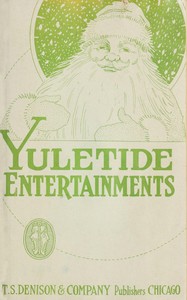
Yuletide entertainments — Themes and Context
(0 User reviews)
1010
Project Gutenberg
2023
Not confirmed
Recitations; Amusements; Dialogues; Amateur plays
Readers of public-domain and historical texts
Project Gutenberg digital edition
en
Edition facts
Words
31,969
Reading time
139 min
Text sections
27
For Yuletide entertainments — Themes and Context, the stored edition analysis reports 31,969 words, 2 hr 19 min estimated reading time, and 27 detected text sections.
The text analysis averages about 13.1 words per sentence, while the detected sections provide another way to judge how the source is divided.
Project Gutenberg metadata also associates the work with “Recitations,” connecting these edition facts with the source record’s subject description.
Source:
Project Gutenberg record #70515
Ellen M. Willard's 1910 collection of Christmas recitations, drills, dialogues, and plays for children and adults, emphasizing precise movement and performance. Excerpts show a mix of verse, song, and character pieces like 'All the Year 'Round' featuring holiday personifications.
Read the complete public-domain text at its original source.
Read on Project GutenbergEllen M. Willard's Yuletide Entertainments (1910) opens with a practical preface that sets the tone: 'Precision of movement is the keynote of success.' The book is a compendium of Christmas-themed recitations, monologues, drills, tableaux, motion songs, exercises, dialogues, and plays, designed for school or community performances. The table of contents lists pieces such as 'The Bell Song,' 'Cranberry March,' and 'Old Aunt Dinah's Christmas,' indicating a mix of sentimental, comic, and instructional material.
The excerpts reveal a work that blends verse, song, and stage directions, with many pieces set to familiar tunes. The longest excerpt, 'All the Year 'Round,' personifies holidays like Saint Patrick, Easter, and Hallowe'en, each entering with a song and dance. Willard's emphasis on exactitude suggests the book is as much a manual for staging as a script collection.
Structure and Performance Focus
The book is divided into two parts: Part I contains recitations, monologues, drills, marches, and motion songs; Part II offers dialogues, exercises, musical pieces, and plays. The preface stresses that 'uncertain gestures in speaking; scattered attack and close in singing; hesitation in acting; and, more than all, careless motions and marching in the drills' are fatal to success. This focus on precision suggests the pieces are meant to be performed with choreographed movement, not merely read aloud. The inclusion of 'motion songs' and 'drills' indicates that physical activity is integral to the entertainment.
Character and Voice in the Excerpts
The excerpt from 'All the Year 'Round' showcases a parade of holiday personifications: Saint Patrick sings to the tune of 'Mush, Mush,' Easter enters with 'Upidee,' and April Fool 'dances in, sings joyously, attitudinizing.' Each character has a distinct voice and song, with stage directions like 'Pat. dances, all keep time' and 'April prances and dances.' The dialogue is simple and rhythmic, designed for group participation. The children in the piece respond with choruses, creating a call-and-response dynamic. This structure suggests that many pieces in the collection rely on familiar tunes and repetitive refrains to engage young performers.
Holiday Variety Beyond Christmas
Despite the title, 'All the Year 'Round' includes Saint Patrick's Day, Easter, April Fool's, May and June, July Fourth, Vacation, and Hallowe'en, each with its own song and dance. This indicates that the collection may not be exclusively Christmas-focused, but rather a year-round resource for school entertainments. The piece ends with a chorus celebrating 'May-time posies' and 'June-time roses,' suggesting a seasonal cycle. The inclusion of 'Vacation Twins' who sing 'we are worth all the rest of the year' adds a playful note. This variety could make the book useful for multiple occasions, not just Yuletide.
Language and Tone
Willard's language is direct and instructional, with a mix of sentimental and comic elements. The preface uses aphorisms like 'What is worth doing at all, is worth doing well.' The verse in 'All the Year 'Round' employs dialect for Saint Patrick ('Oh, me darlin's') and simple rhymes for children. The stage directions are precise: 'Valentine retires. Saint Patrick enters, salutes, and sings.' The tone is cheerful and moralistic, with no dark or complex themes. The pieces are clearly designed for easy memorization and performance, with repeated choruses and simple melodies.
When reading Yuletide Entertainments, pay attention to the stage directions and tune indications, as they are essential to the intended effect. The book is a practical tool, not a literary work; its value lies in performance. The excerpts suggest that many pieces are adaptable for different ages and group sizes. Consider how the emphasis on precision might shape a modern reading—whether as a historical artifact or a source for actual staging.
Flipping through Ellen Willard's precise little stage directions, I found myself thinking of the breathless, fluttery energy in that other old volume. Hers asks for practiced control, while the girls' comedy feels like what happens when that control slips—a happy accident, perhaps. It’s a quiet contrast, holding both together like pressed leaves in a favorite book. That Awful Letter: A Comedy for Girls — Reading Notes lingers in the same drawer, a gentler shadow of that same holiday urgency.
There are no reviews for this eBook.
There are no comments for this eBook.
Reader reflection
Your personal reading reflection
Build a private reading journal entry for this title.
Your progress
0
/
10
2
Did this book hold your interest?
3
Would you pass this book on to a friend?
4
Did the language feel accessible?
5
How well did it match your expectations?
6
How personally connected did you feel to the book?
7
How valuable was this book for your own interests?
8
How original did the book feel?
9
What changed or sharpened your thinking?
10