1

That Awful Letter: A Comedy for Girls — Reading Notes
(0 User reviews)
327
Project Gutenberg
2016
Not confirmed
Comedy plays; Young women -- Drama; Snobs and snobbishness -- Drama; Cousins -- Drama
Readers of public-domain and historical texts
Project Gutenberg digital edition
en
Edition facts
Words
10,697
Reading time
47 min
Text sections
6
The catalog record for That Awful Letter: A Comedy for Girls — Reading Notes provides practical reading context through 10,697 words, 47 min estimated reading time, and 6 detected text sections.
The text analysis averages about 14.0 words per sentence, while the detected sections provide another way to judge how the source is divided.
Project Gutenberg metadata also associates the work with “Comedy plays,” connecting these edition facts with the source record’s subject description.
Source:
Project Gutenberg record #52818
In this comedy for girls, a letter reveals a snobbish cousin's true nature, leading to a playful scheme of comeuppance through amateur theatricals and mistaken identity.
Read the complete public-domain text at its original source.
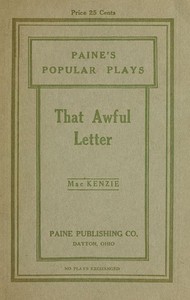
Read on Project GutenbergEdna I. MacKenzie's That Awful Letter: A Comedy for Girls opens with a group of young women reminiscing about boarding-school escapades—midnight feasts, hiding from teachers, and amateur plays. The dialogue is brisk and colloquial, peppered with exclamations like “Oh, but it was exciting!” and “Say, you just ought to know Beth.” The play’s central conflict emerges when Edith receives a letter from her friend Beth, who plans to visit and “take down a peg” her snobbish cousin. Unbeknownst to Edith, that cousin is Margaret, who is present and overhears the plan. The catalog subjects list “Comedy plays,” “Young women,” “Snobs and snobbishness,” and “Cousins,” all of which are directly dramatized in the excerpts.
The Letter as Catalyst
The titular “awful letter” is never quoted verbatim in the excerpts, but its contents are inferred through dialogue. Edith reports that Beth described her cousin as “some snobbish cousin of hers who needs to be taken down a peg or two.” This offhand remark sets the plot in motion: Margaret, the cousin, realizes she is the target and confesses, “I don’t deserve to have her ever speak to me again.” The letter functions as a dramatic device that reveals character and motivates action, rather than being a physical prop. The play’s title thus points to a written document that is more talked about than seen, a choice that emphasizes the power of words to shape social dynamics.
Performance and Identity
The excerpts highlight a recurring interest in theatricality. Edith praises Beth’s acting: “She was just bubbling over with fun and mischief… she had all the professionals beaten to pieces.” Later, Beth disguises herself as a “country gawk” to teach Margaret a lesson, a performance that Margaret later acknowledges: “She’s acted that country gawk I inferred in that letter to take me down that peg.” The play within the play—amateur theatricals at school—mirrors the larger plot of assumed identities. Margaret’s shock at discovering Beth’s disguise underscores how performance can expose hypocrisy. The dialogue’s frequent use of stage directions like “aside in horror” and “gazes at Margaret” reinforces the work’s self-awareness as a script meant for performance.
Snobbery and Its Remedies
The catalog subject “Snobs and snobbishness” is directly addressed through Margaret’s arc. Initially, she is described by Beth as a snob, and her own actions—such as treating Elizabeth poorly—confirm this. However, upon learning the truth, Margaret admits, “I’m so ashamed. I wish there was a hole in the floor so that I could crawl into it.” Her friend Helen responds, “Thank goodness, she’s admitted that much. There’s hope for her yet.” The play suggests that snobbery can be corrected through embarrassment and self-reflection, rather than punishment. Margaret’s line “the worse the medicine tastes, as a rule, the better are the results” encapsulates a moral lesson about humility. The excerpts do not reveal the full resolution, but the trajectory points toward reconciliation.
Readers approaching That Awful Letter should note that the excerpts represent only a portion of the play; the full text may develop the letter’s contents and the resolution of the cousinly conflict. The work is structured as a one-act comedy, likely intended for amateur performance by young women. Its brisk dialogue and reliance on mistaken identity align with early twentieth-century domestic comedies. Pay attention to how MacKenzie uses offstage events—the letter, Beth’s disguise—to drive onstage action, a technique that keeps the focus on character reactions rather than spectacle.
That comic letter’s unravelling made me think of how a royal court’s whispers can shift a throne, much like a cousin’s snobbery shifts a family. There’s a quiet satisfaction in watching pretense topple, whether on a school stage or at Whitehall. I still recall the gentle irony of King Henry VIII — Reading Companion, and how both tales laugh at our small vanities.
There are no reviews for this eBook.
There are no comments for this eBook.
Reader reflection
How will you remember this book?
Save your reaction, strongest insight, and memorable passage.
Your progress
0
/
10
2
How did the book work for you overall?
3
Would you encourage someone else to read it?
4
How demanding did the text feel?
5
Do you expect to return to this book?
6
How closely did the book connect with your experience?
7
How useful were the ideas in this book?
8
Would this book work well in a reading group?
9
In one sentence, what did you learn?
10