1

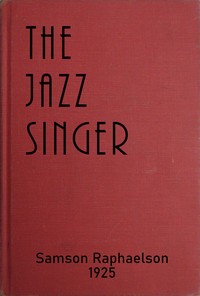
The Jazz Singer — A Reader’s Guide
(0 User reviews)
56
Project Gutenberg
2022
Not confirmed
New York (N.Y.) -- Drama; Jewish singers -- Drama; Fathers and sons -- Drama; Cantors (Judaism) -- Drama; Jewish families -- Drama
Readers of public-domain and historical texts
Project Gutenberg digital edition
en
Edition facts
Words
26,949
Reading time
118 min
Text sections
11
For The Jazz Singer — A Reader’s Guide, the stored edition analysis reports 26,949 words, 1 hr 58 min estimated reading time, and 11 detected text sections.
The text analysis averages about 9.7 words per sentence, while the detected sections provide another way to judge how the source is divided.
Project Gutenberg metadata also associates the work with “New York (N.Y.) -- Drama,” connecting these edition facts with the source record’s subject description.
Source:
Project Gutenberg record #67583
Samson Raphaelson's 1925 play contrasts the fervor of jazz with traditional piety, centering on a Jewish cantor's son torn between Broadway and his father's world. The preface frames jazz as 'prayer distorted,' while scenes show the protagonist navigating love, ambition, and cultural collision.
Read the complete public-domain text at its original source.
Read on Project GutenbergIn his 1925 preface, Samson Raphaelson declares jazz 'prayer distorted, sick, unconscious of its destination'—a claim that anchors this play's central tension. The story follows Jack Robin, a Jewish cantor's son who becomes a Broadway performer, caught between his father's religious expectations and his own artistic drive. Raphaelson, drawing on his earlier story 'The Day of Atonement,' structures the drama around collisions: sacred versus secular, Old World versus New, surface versus depth. The preface explicitly rejects static depictions of American life, calling instead for a 'kaleidoscopic' portrait of 'vivid contrast of surfaces.'
Jazz as a Contested Symbol
Raphaelson's preface does not treat jazz merely as music but as a cultural symptom. He describes it as 'the rhythm of frenzy staggering against a symphonic background' composed of 'lewdness, heart's delight, soul-racked madness, monumental boldness, exquisite humility, but principally prayer.' This paradoxical list suggests that jazz, for all its apparent chaos, carries a spiritual weight. The author explicitly links the jazz singer to Matthew Arnold's figure of the Jew 'lost between two worlds, one dead, the other powerless to be born.' The play itself dramatizes this liminality: Jack Robin performs in comedy costume and a 'huge comedy cigar,' yet his father's world—signaled by the arrival of Yudelson, a diamond dealer who calls him 'Jakele'—pulls him back to his roots. The preface's claim that 'jazz is prayer' is tested in scenes where professional ambition and personal loyalty collide.
Surface and Depth in Character Interaction
The excerpted scene between Jack, Mary, and Randolph Dillings reveals Raphaelson's method of using social friction to expose deeper conflicts. Dillings, described as 'fearfully rich and awfully nice, but old-fashioned,' snubs Jack not out of personal animus but because Jack represents a world Dillings cannot accept. Jack's response—initially playful ('Thank God, THAT'S settled!'), then hurt—shows his vulnerability beneath the performer's bravado. Mary's role as intermediary highlights the play's interest in class and cultural boundaries: she is comfortable with both Dillings's old-money propriety and Jack's show-business energy. The stage directions emphasize physical positioning—Jack 'backs out of the scene and sits on the trunk' after the snub—using blocking to reinforce emotional distance. Raphaelson's dialogue, with its overlapping rhythms of flippancy and earnestness, mirrors the 'kaleidoscopic' surfaces he advocates in the preface.
The Weight of the Past in a Single Name
When Yudelson enters looking for 'Jakie Robin,' the diminutive instantly reconnects Jack to his childhood and community. The stage direction has Jack react with disbelief: 'Yudelson? It can't be.' This moment, though brief, carries the play's central conflict in miniature. The name 'Jakie' belongs to the world of the cantor's son, the world of Yudelson the diamond dealer—a world of Yiddish-inflected familiarity and religious obligation. Jack's current identity as 'Jack Robin,' Broadway performer, is a deliberate construction, and Yudelson's arrival threatens to collapse it. The play does not resolve this tension in the excerpt; instead, it leaves Jack caught between two modes of address. Raphaelson's preface describes the jazz singer as 'a solitary figure, a lost soul, dancing grotesquely on the ruins' of cathedrals and temples. In this scene, the ruins are personal: the name 'Jakie' is a ghost that Jack cannot fully exorcise.
Readers should attend to the play's stage directions, which often carry as much weight as the dialogue. Raphaelson uses physical movement—a character backing away, a hat tipped in mockery, a trunk serving as a perch—to articulate what words leave unsaid. The preface offers a provocative lens, but the play itself tests that lens through specific, often awkward human encounters. Notice how characters speak past each other, how silences and interruptions fracture the flow. The jazz singer's prayer may be 'distorted,' but it is no less urgent for being so.
I keep thinking about the cantor's son in Samson Raphaelson's play, the way his whole self seemed to strain between two irreconcilable songs. It made me remember a quieter, older echo of that same restlessness in Penelope: A Comedy in Three Acts — Themes and Context — its gentle tug between domestic expectation and a private, wandering heart. Both feel like the same ache, just wearing different clothes.
There are no reviews for this eBook.
There are no comments for this eBook.
Reader reflection
How did this book work for you?
Your answers remain private and are stored only in this browser.
Your progress
0
/
10
2
How did the book work for you overall?
3
Would you encourage someone else to read it?
4
How much effort did this book require?
5
Would you start a conversation about this book?
6
Did this book create an emotional response?
7
Did the book offer a fresh perspective?
8
Which part made the strongest impression?
9
What did this book teach you most?
10