1

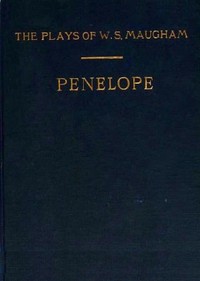
Penelope: A Comedy in Three Acts — Themes and Context
(0 User reviews)
1602
Project Gutenberg
2015
Not confirmed
Man-woman relationships -- Drama; Married people -- Drama; English drama -- 20th century; England -- Social life and customs -- 20th century -- Drama
Readers of public-domain and historical texts
Project Gutenberg digital edition
en
Edition facts
Words
32,248
Reading time
141 min
Text sections
8
The source record for Penelope: A Comedy in Three Acts — Themes and Context measures this digital text at 32,248 words, 2 hr 21 min estimated reading time, and 8 detected text sections.
The text analysis averages about 10.7 words per sentence, while the detected sections provide another way to judge how the source is divided.
Project Gutenberg metadata also associates the work with “Man-woman relationships -- Drama,” connecting these edition facts with the source record’s subject description.
Source:
Project Gutenberg record #50180
Maugham's 1909 comedy uses brisk dialogue and stage directions to expose marital tensions in a Mayfair drawing-room. The play's three acts shift from farcical misunderstandings to sharper emotional exchanges, with Penelope's quiet manipulation and the doctor's professional detachment driving the plot.
Read the complete public-domain text at its original source.
Read on Project GutenbergMaugham's Penelope opens not with the title character but with a servant's imperturbable refusal to explain her mistress's absence. The stage directions immediately establish a tone of polite absurdity: the pompous Mr. Davenport Barlow is handed a newspaper and offered whisky while Penelope delays her entrance. This comic deferral sets up the play's central dynamic—characters who speak past one another, using social rituals to mask private agendas.
The dialogue moves in clipped, ironic exchanges. Barlow's fussy self-importance is undercut by the maid's flat responses, and the rhythm of interruption and non sequitur recurs throughout. Maugham's voice favors epigrammatic deflation over emotional disclosure, a technique that keeps the comedy brittle and the characters' motives deliberately opaque.
Stage Business and Social Signals
The play's printed text is unusually rich in physical detail. Stage directions specify not just entrances and exits but the exact placement of objects—a cheque left on a desk, a two-shilling piece placed beside sovereigns—and the characters' small, telling gestures. When Mrs. Fergusson asks Dickie for money, the stage direction notes that he “gives a slight start, and his face falls” before he composes himself. These micro-movements carry the emotional weight that the dialogue deflects.
Maugham uses props as shorthand for social performance. The whisky-and-soda offered to Barlow, the Morning Post handed to him as a pacifier, the “imposing fee” arranged for show—each object signals a character's role in a transaction that is never quite what it seems. The stage itself becomes a space where appearances are managed, and the reader must watch the actors' hands as closely as their words.
The Rhythm of Interruption
Conversations in Penelope rarely proceed in a straight line. Characters break off mid-sentence, change topics abruptly, or let a remark hang unfinished. When Mrs. Fergusson begins to explain her financial trouble, she hedges: “Of course it's nothing very important really, but it's just a little awkward to ask.” Dickie interrupts her before she can finish, and the negotiation that follows is a series of false starts and polite deflections.
This staccato rhythm creates a surface of triviality while hinting at unspoken tensions. The interruptions are not random; they are strategies. Mrs. Fergusson steers the conversation toward money by pretending to forget her main purpose. Dickie cuts her off to assert control. The play's comedy depends on these verbal feints, and the reader must attend to what is not said as much as to what is.
Names, Titles, and Social Fabrication
Maugham peppers the dialogue with references to names and identities that are knowingly false. Mrs. Fergusson admits she is “a Jones of Llan—” before cutting herself off, and earlier she claims to be a Fergusson of Glengary to impress Barlow. The joke is that Barlow, a snob, is easily fooled. Dickie's dry comment—“Good old Scotch name, that's all”—when he hears the name Solly Abrahams underscores the ethnic and class stereotypes that the characters deploy casually.
Names function as props in the social game. The Johannesburg and New Jerusalem gold mine is a transparent invention, yet it serves its purpose. The play's world is one where identity is fluid and performance is constant. Penelope herself, though she appears little in the excerpts, is the orchestrator of these performances—the one who sends telegrams, delays arrivals, and sets the stage for others to reveal themselves.
Readers approaching Penelope as a text rather than a performance should pay particular attention to the stage directions, which carry much of the subtext. The play's three acts build toward a resolution that the excerpts only hint at, but the pattern of evasion and revelation is established early. Maugham's comedy is a mechanism of timing and misdirection; the pleasure lies in watching the gears turn.
Reading Penelope again, I kept thinking of the quieter, more domestic ache in Mary Broome: A Comedy, in Four Acts — Reading Notes. Both plays hold that peculiar Edwardian tension—laughter just barely covering something sadder underneath—but where Penelope schemes, Mary simply waits. There's a tenderness there that stays with you, like the afternoon light fading in a drawing-room, long after the curtain falls.
There are no reviews for this eBook.
There are no comments for this eBook.
Reader reflection
Your personal reading reflection
Build a private reading journal entry for this title.
Your progress
0
/
10
2
Was reading this book enjoyable?
3
How likely are you to recommend this book?
4
Did the language feel accessible?
5
Do you expect to return to this book?
6
How did the pace of the book feel?
7
How personally connected did you feel to the book?
8
How valuable was this book for your own interests?
9
What did this book teach you most?
10