1

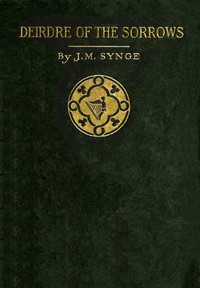
Deirdre of the Sorrows — Reading Companion
(0 User reviews)
368
Project Gutenberg
1999
Not confirmed
Deirdre (Legendary character) -- Drama; Epic literature, Irish -- Adaptations; Tales -- Ireland -- Adaptations; Queens -- Drama; Ireland -- Drama
Readers of public-domain and historical texts
Project Gutenberg digital edition
en
Edition facts
Words
19,315
Reading time
84 min
Text sections
6
For Deirdre of the Sorrows — Reading Companion, the stored edition analysis reports 19,315 words, 1 hr 24 min estimated reading time, and 6 detected text sections.
The text analysis averages about 15.3 words per sentence, while the detected sections provide another way to judge how the source is divided.
Project Gutenberg metadata also associates the work with “Deirdre (Legendary character) -- Drama,” connecting these edition facts with the source record’s subject description.
Source:
Project Gutenberg record #1922
Synge's three-act play adapts the Irish legend of Deirdre, focusing on the tension between her desire for freedom and the political machinations of King Conchubor. The excerpts reveal a spare, rhythmic dialogue and a setting that mirrors emotional states.
Read the complete public-domain text at its original source.
Read on Project GutenbergThe play opens in Lavarcham's bare house on Slieve Fuadh, where the nurse's anxiety about Deirdre's absence is palpable. The dialogue immediately establishes a world of watchfulness and foreboding: the Old Woman reports that the Sons of Usna are nearby, and Lavarcham fears they might see Deirdre. Conchubor's jealousy is described as being 'jealous of a hawk would fly between her and the rising sun,' a vivid image that sets the tone for the possessive love that drives the plot.
A World of Spare, Rhythmic Speech
The dialogue in the excerpts is notably economical, with characters often speaking in short, rhythmic phrases that convey emotion through repetition and parallelism. For example, Lavarcham's line 'It's dark with the clouds are coming from the west and south, but it isn't later than the common' uses a simple, almost musical structure. This style, characteristic of Synge's Hiberno-English, gives the play a folkloric quality while keeping the language grounded in physical details—'the butt of the stone,' 'a load of twigs.' The characters' speech often carries a double meaning, as when Owen scatters gold and says 'Are you paid, Fergus?'—a line that hints at betrayal without explicit accusation.
Setting as Emotional Landscape
The physical environment in the excerpts is never neutral. Lavarcham's house is 'neat and clean but bare,' reflecting the austerity of Deirdre's secluded upbringing. The hills and glens are described in terms of their emotional charge: the Old Woman notes that Naisi and his brothers are 'above chasing hares,' and Lavarcham fears the gods might 'send they don't set eyes on her.' Later, the sea and the curaghs (boats) become symbols of escape and return. The stage directions—'subdued like men at a queen's wake'—use simile to link the setting directly to the characters' inner states, creating a landscape that is both literal and psychological.
The Weight of Prophecy and Choice
Throughout the excerpts, characters speak of warnings and fate, but the play does not present Deirdre as a passive victim. Lavarcham says Deirdre 'was meant to have her pleasure only,' and Deirdre herself asserts her agency: 'I have chosen to go back with Fergus.' The tension between foreknowledge and free will is embodied in Owen, who 'knew a power if he'd said it all' but dies by his own hand. The characters' decisions—to return to Emain, to trust Fergus—are made with full awareness of the risks, yet they proceed. This interplay between destiny and choice gives the drama its momentum, as each character's actions seem both inevitable and freely chosen.
Love and Its Costs in Seven Years
Deirdre and Naisi's relationship is defined by its duration: 'seven years without roughness or growing weary.' This repeated phrase underscores the rarity of their love, but also its fragility. Deirdre's decision to return to Emain is motivated by a desire to avoid 'a love had no match and it wasting away.' The play thus questions whether perfect love can endure, or whether it must be preserved by ending it. The brothers' protests—'We will not take you to Emain'—highlight the personal cost of their loyalty, while Deirdre's plea 'Will you quarrel with me, Ainnle, though I have been your queen these seven years?' shows how love binds the group together even as it threatens to tear them apart.
Readers approaching Deirdre of the Sorrows for the first time will find a play that rewards attention to its language and structure. Synge's dialogue, with its deliberate rhythms and repetitions, creates a world where every word carries weight. The excerpts offer a clear view of the central conflict—between personal desire and political duty—but the play's power lies in its ambiguity: no character is wholly right or wrong. Pay close attention to the stage directions and the way characters' movements mirror their emotional states; they are as much a part of the drama as the spoken lines.
I’ve often thought Conchubor’s shadow over Deirdre carries the same grey weight as the gods’ whims in The Tragedy of Dido Queene of Carthage — Reading Companion. Both plays hum with that hush before a sacrifice—the characters choosing love, then suffering for it. A familiar ache, preserved on my shelf like pressed heather.
There are no reviews for this eBook.
There are no comments for this eBook.
Reader reflection
How will you remember this book?
Save your reaction, strongest insight, and memorable passage.
Your progress
0
/
10
2
What was your overall reaction to the book?
3
How likely are you to recommend this book?
4
Did the language feel accessible?
5
Did any part of the book feel personally relevant?
6
How distinctive were its ideas or approach?
7
Was the book what you thought it would be?
8
Did the story or argument move comfortably?
9
In one sentence, what did you learn?
10