1

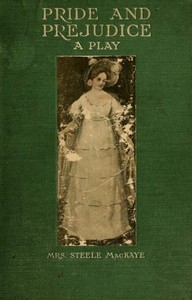
Pride and Prejudice, a play founded on Jane Austen's novel — Context and Discussion
(0 User reviews)
2061
Project Gutenberg
2011
Not confirmed
England -- Drama; Courtship -- Drama; Young women -- Drama; Social classes -- Drama; Domestic drama; Sisters -- Drama; Bennet, Elizabeth (Fictitious character) -- Drama
Readers of public-domain and historical texts
Project Gutenberg digital edition
en
Edition facts
Words
30,754
Reading time
134 min
Text sections
6
The catalog record for Pride and Prejudice, a play founded on Jane Austen's novel — Context and Discussion provides practical reading context through 30,754 words, 2 hr 14 min estimated reading time, and 6 detected text sections.
The text analysis averages about 10.6 words per sentence, while the detected sections provide another way to judge how the source is divided.
Project Gutenberg metadata also associates the work with “England -- Drama,” connecting these edition facts with the source record’s subject description.
Source:
Project Gutenberg record #37431
Mrs. Steele MacKaye's 1906 stage adaptation condenses Austen's novel into a four-act play, preserving key dialogue and character dynamics while compressing the plot. The script includes detailed stage directions and a character list with quotations from the original novel.
Read the complete public-domain text at its original source.
Read on Project GutenbergMrs. Steele MacKaye's 1906 dramatization of Pride and Prejudice opens not with the famous line about a truth universally acknowledged, but with a stage direction: a drawing-room at Longbourn, morning, Mrs. Bennet entering in a flutter. The play compresses Austen's novel into four acts, retaining key scenes such as the Meryton ball, Mr. Collins's proposal, and the confrontation with Lady Catherine. MacKaye's adaptation is notable for its fidelity to Austen's dialogue—many speeches are lifted nearly verbatim—while also adding theatrical flourishes: characters exit and enter on cue, and asides are delivered directly to the audience. The result is a brisk, stageworthy version that emphasizes the comedy and social tension of the original.
Compression and Selection
MacKaye's play reduces Austen's intricate plot to a series of set pieces. The opening act covers the arrival of Bingley and Darcy, the Meryton ball, and Jane's illness at Netherfield—events that span several chapters in the novel. Key omissions include the entire subplot of Lydia's elopement (only mentioned in passing) and the visit to Pemberley. Instead, the focus remains squarely on Elizabeth and Darcy's antagonism and gradual reconciliation. The play's structure relies on a few pivotal scenes: the first ball, Mr. Collins's proposal, Darcy's first proposal, and the final confrontation with Lady Catherine. This selection gives the adaptation a tight, almost claustrophobic focus on the central romance.
Stage Directions as Character Clues
MacKaye's stage directions offer revealing glimpses into character. Darcy is described as "haughty, reserved and fastidious" with "manners, though well-bred, were not inviting." Elizabeth is "quick, observant, and witty." More strikingly, the directions often indicate characters' internal states through physical action: during Bingley's announcement of his departure, Darcy stands "with folded arms, staring at the ceiling," while Miss Bingley wears a "triumphant smile." These visual cues compensate for the loss of Austen's narrative voice, translating psychological nuance into theatrical gesture. The play also includes asides—for instance, Elizabeth's muttered "Oh, hush, mamma!"—that preserve her ironic perspective.
Theatricality and Social Performance
The play heightens the novel's theme of social performance. Characters are constantly aware of being watched: Sir William Lucas proposes toasts with theatrical flourish, and Mrs. Bennet's outbursts are played for comic effect. The ball scene becomes a stage within a stage, where Bingley's announcement of his departure causes "great consternation" and Jane looks down. MacKaye uses the physical space of the stage to underscore power dynamics: Darcy often stands apart, while Elizabeth moves between groups. The final scene, with Lady Catherine's confrontation, is a dramatic set piece that relies on verbal sparring rather than physical action. This adaptation reminds us that Austen's world is one of carefully managed appearances, where every word and gesture is a performance.
Readers familiar with the novel will notice what is missing: the narrative irony, the extended reflections, the subplots involving Lydia and Wickham. But MacKaye's play offers something else—a concentrated, theatrical version that lets Austen's dialogue and character dynamics shine. It is best approached as a period adaptation, one that reveals how early twentieth-century dramatists interpreted Austen for the stage. Pay attention to the stage directions: they are the playwright's commentary, filling the gaps left by the absent narrator.
That rainy afternoon, I kept returning to Mrs. MacKaye's stage directions—how she compressed Elizabeth's wit into four tight acts, leaving the drawing-room air almost breathless. Later, flipping idly through Mary Broome: A Comedy, in Four Acts — Reading Notes, I felt that same clipped urgency, that sense of conversations barely containing their consequences, as if both plays shared one quiet, rain-streaked window.
There are no reviews for this eBook.
There are no comments for this eBook.
Reader reflection
Your personal reading reflection
Build a private reading journal entry for this title.
Your progress
0
/
10
2
How much did you enjoy the reading experience?
3
How likely are you to recommend this book?
4
What was the reading difficulty like?
5
How original did the book feel?
6
Could you follow the author’s main argument?
7
How strong was your personal connection to the text?
8
How useful were the ideas in this book?
9
What is the main idea you are taking away?
10