1

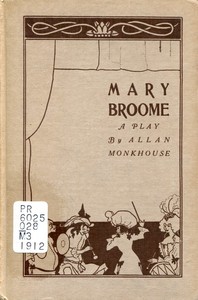
Mary Broome: A Comedy, in Four Acts — Reading Notes
(0 User reviews)
1832
Project Gutenberg
2014
Not confirmed
Marriage -- Drama; England -- Drama; Man-woman relationships -- Drama; Social classes -- Drama; Adultery -- Drama
Readers of public-domain and historical texts
Project Gutenberg digital edition
en
Edition facts
Words
24,000
Reading time
105 min
Text sections
8
Before opening Mary Broome: A Comedy, in Four Acts — Reading Notes, the edition data offers a quick orientation: 24,000 words, 1 hr 45 min estimated reading time, and 8 detected text sections.
The text analysis averages about 9.2 words per sentence, while the detected sections provide another way to judge how the source is divided.
Project Gutenberg metadata also associates the work with “Marriage -- Drama,” connecting these edition facts with the source record’s subject description.
Source:
Project Gutenberg record #46298
Allan Monkhouse's 1911 comedy dissects class and marriage through the marriage of housemaid Mary Broome to Leonard Timbrell. The play's four acts shift from light banter to tense confrontations, with dialogue revealing social pressures and economic realities. The excerpts show a sharp ear for vernacular speech and the awkwardness of cross-class intimacy.
Read the complete public-domain text at its original source.
Read on Project GutenbergAllan Monkhouse's Mary Broome: A Comedy, in Four Acts (1911) opens with a drawing-room scene whose stage direction notes furniture 'in middling taste'—a small but telling detail that signals the play's interest in the textures of middle-class life. The dialogue immediately establishes a tone of brittle banter: Edgar Timbrell tells his fiancée Sheila she 'won't often have the chance of being married,' and she retorts that she wants 'one delightful reality' instead of 'all those chances.' The arrival of Mary Broome, the housemaid, shifts the register. Her 'self-possession' is noted in the stage direction, and her first line—'A parcel for you, sir'—is plain, efficient, and devoid of deference. The play's comedy, then, is built on the friction between these two worlds.
Voice and Social Markers
The excerpts reveal a careful ear for class-inflected speech. The Timbrell family and their circle use a clipped, ironic idiom: Edgar's 'For Heaven's sake remember who sent them all' and Leonard's mock-legal threat to Mrs. Greaves ('It's slander. They give very heavy damages now for slander.') are both performances of superiority. Mrs. Greaves, the greengrocer, speaks in a different rhythm—'I must tell you, perfectly frank, that there's been some talk about you'—with a directness that the Timbrells treat as comic. Mary's own speech is notably terse and practical: 'No more milk?' and 'Solicitors like to be paid, too.' She does not mimic the family's verbal games. Monkhouse uses these contrasts not for easy mockery but to show how language itself becomes a barrier and a weapon.
Pace and the Pressure of Money
The play's four acts move from the leisurely opening—presents, wedding talk, a new silk hat—to scenes where money dominates the rhythm. The confrontation with Mrs. Greaves is a good example: Leonard's joking deflection ('We're all in the same boat') is undercut by Mary's insistence that the bill be paid. The exchange accelerates as Leonard threatens slander, then pivots to a mock budget ('The first money we get is for a perambulator'). The comedy here is uneasy; the audience is asked to laugh at Leonard's evasions while noting that Mary is the one who calls them unfair. The pace shifts from banter to something sharper, and the stage directions—'With mock vexation,' 'Doubtfully'—signal that the characters themselves are unsure how to play these scenes.
The Housemaid's Perspective
Mary Broome is given few lines in the excerpts, but those lines carry weight. Her first entrance is marked by 'self-possession,' and she does not defer to the family's conversational style. When Leonard jokes about pawning his watch, Mary's response—'There's your watch'—is flat and practical, puncturing his performance. Later, she tells Mrs. Greaves, 'I think he's joking,' a line that both reassures and distances her from Leonard's tactics. The play's title promises a comedy, but Mary's role seems to be that of a quiet realist. The excerpts do not reveal her inner life, but they show her as a character who observes and judges, even when she does not speak. This restraint is a deliberate choice: the comedy depends on what Mary does not say.
Readers approaching Mary Broome should attend to the stage directions, which often undercut the dialogue. The description of Ada and Sheila as 'ordinary middle-class young women who might develop in all manner of unexpected ways and usually do not' is a clue to Monkhouse's ironic stance. The play's comedy is not gentle; it is built on the gap between what characters say and what the audience sees. Watch for moments when a character's speech is contradicted by a stage direction or by another character's silence. The four-act structure itself may be a clue: each act likely tightens the pressure on the marriage at the center of the play.
This play reminded me of chattering in the Timbrells' drawing-room while Mary stood silently by, and I thought of my grandmother, a maid who never spoke of such things. Reading it, I felt the same quiet ache I got from the linked Washington Square Plays — Edition Insights, where small rooms hold enormous, unspoken weights. Both books leave a hush after the last page.
There are no reviews for this eBook.
There are no comments for this eBook.
Reader reflection
How will you remember this book?
Save your reaction, strongest insight, and memorable passage.
Your progress
0
/
10
2
Was reading this book enjoyable?
3
Would you pass this book on to a friend?
4
How easy was the book to follow?
5
Was the book easy to understand?
6
How valuable was this book for your own interests?
7
Which element worked best for you?
8
How strongly did the book affect you emotionally?
9
What changed or sharpened your thinking?
10