1

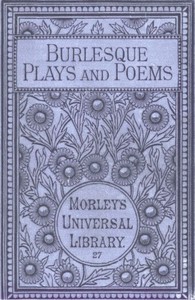
Burlesque Plays and Poems — A Reader’s Guide
(0 User reviews)
370
Project Gutenberg
2016
Not confirmed
English poetry; Burlesques; English drama
Readers of public-domain and historical texts
Project Gutenberg digital edition
en
Edition facts
Words
112,892
Reading time
491 min
Text sections
23
The source record for Burlesque Plays and Poems — A Reader’s Guide measures this digital text at 112,892 words, 8 hr 11 min estimated reading time, and 23 detected text sections.
The text analysis averages about 16.9 words per sentence, while the detected sections provide another way to judge how the source is divided.
Project Gutenberg metadata also associates the work with “English poetry,” connecting these edition facts with the source record’s subject description.
Source:
Project Gutenberg record #53606
Henry Morley's 1885 anthology collects English burlesque from Chaucer's 'Rime of Sir Thopas' to 19th-century parodies, including plays by Fielding, Carey, and Buckingham. The excerpts show how burlesque targets literary conventions through exaggerated diction, mock-heroic plots, and self-conscious theatricality.
Read the complete public-domain text at its original source.
Read on Project GutenbergHenry Morley's 1885 anthology collects English burlesque from Chaucer's 'Rime of Sir Thopas' to early 19th-century parodies, including plays by Fielding, Carey, and Buckingham. The excerpts reveal a tradition that targets literary conventions through exaggerated diction, mock-heroic plots, and self-conscious theatricality. In Chrononhotonthologos, for instance, the king's 'cogibundity of cogitation' and threats to 'outstare eternity' parody tragic bombast, while the stage direction for a 'grand pantomime entertainment' underscores the genre's playful use of spectacle.
Morley's introduction frames these works as 'burlesque'—a term encompassing parody, travesty, and satire. The collection's structure, moving from Chaucer to the Rejected Addresses, suggests a historical arc, though the excerpts focus on dramatic pieces. Readers should attend to how each work twists familiar forms: the mock-heroic Splendid Shilling inflates a trivial subject, while The Rehearsal mocks Restoration heroic drama.
The Opening: Chaucer's 'Rime of Sir Thopas' as a Burlesque Foundation
The anthology opens with Chaucer's 'Rime of Sir Thopas,' a deliberate choice that establishes burlesque as a longstanding English tradition. In the Canterbury Tales, Chaucer parodies medieval romances through a knight whose adventures are absurdly repetitive—'He dide next his white leere / Of cloth of lake fyn and cleere'—and whose quest is interrupted by the Host's complaint. Morley's inclusion signals that burlesque need not be low comedy; it can be a sophisticated literary critique. The excerpt shows Chaucer using the same techniques later playwrights would employ: inflated language, anticlimax, and a knowing narrator. Readers should note how the poem's structure—a romance reduced to a list of clichés—prefigures the mock-heroic of The Splendid Shilling and the dramatic parodies of The Rehearsal. The 'Rime' also demonstrates that burlesque often targets specific genres (here, chivalric romance) rather than general absurdity.
The Middle: <em>Chrononhotonthologos</em> and the Parody of Heroic Drama
Carey's Chrononhotonthologos (1734) is the anthology's most extended example of dramatic burlesque. The excerpt captures its method: characters speak in pompous blank verse ('This god of sleep is watchful to torment me'), but the plot is ludicrous—a king declares 'Henceforth let no man sleep, on pain of death' and then faces an invasion from 'antipodean pow'rs.' The play's humor lies in the gap between grand language and trivial action. Note how the servant Rigdum-Funnidos punctures the king's rhetoric with plain questions ('Pray who is this Mr. Somnus?'), a technique also used in The Rehearsal. The stage directions, such as 'a grand pantomime entertainment is performed,' highlight burlesque's reliance on theatrical spectacle. Carey also mocks the conventions of heroic drama: the king's soliloquy, the queen's dawn speech ('Day's curtain drawn'), and the battle report delivered in hyperbolic terms. Readers should compare this to Fielding's Tom Thumb the Great, which similarly inflates a trivial subject to epic proportions.
The Later Excerpts: <em>Rejected Addresses</em> and Parody of Contemporary Poetry
The later sections include the Rejected Addresses (1812), a collection of parodies of Romantic poets written by James and Horace Smith. The excerpts show a shift from dramatic to poetic burlesque, targeting specific authors rather than genres. For instance, 'The Baby's Debut' mimics Wordsworth's simple style, while 'Cui Bono?' parodies Southey's moralizing. The anthology's inclusion of these pieces alongside earlier works demonstrates the evolution of burlesque from stage to page. The Rejected Addresses were originally submitted (and rejected) for the reopening of Drury Lane Theatre, giving them a specific historical context. Readers should note how the parodies rely on exaggerated versions of each poet's diction and subject matter—Wordsworth's focus on childhood, Southey's oriental tales. Unlike the dramatic burlesques, these poems are self-contained and require knowledge of the originals. The anthology also includes odes to figures like Mr. Graham and Mr. M'Adam, extending the parody to contemporary public figures.
Structure and Voice: How the Anthology Frames Burlesque
Morley's editorial choices shape how readers encounter these works. The table of contents groups pieces by author or period, but the excerpts reveal a consistent emphasis on verbal play and theatricality. The introduction, though not excerpted, likely provides historical context; the anthology's subtitle—'Burlesque Plays and Poems'—suggests a broad definition. The excerpts show that burlesque often uses elevated diction for low subjects (the 'Splendid Shilling' describes a coin in Miltonic verse) or low diction for high subjects (the king in Chrononhotonthologos threatening to 'tear thine eyeballs'). The collection also includes works that blur genres: The Rehearsal is a play-within-a-play, while Bombastes Furioso parodies opera. Readers should pay attention to the paratexts—the title pages, the list of Morley's Universal Library—which position these works as both entertainment and literary history. The anthology's arrangement, from Chaucer to the 19th century, implies a tradition, but the excerpts are best read as individual experiments in parody.
This anthology rewards readers who approach each piece as a conversation with its source material. The burlesques are not mere jokes but critical commentaries, using exaggeration to expose the conventions of their targets. For a first reading, focus on the gap between form and content: why does a trivial subject demand epic treatment? How does the parody reveal the original's weaknesses? The collection's range—from Chaucer to the Rejected Addresses—offers a survey of English literary satire, but each work stands alone as a demonstration of how laughter can sharpen literary judgment.
I kept thinking about Morley’s burlesque collection long after closing it—how the mock-heroic poems laugh at their own grand gestures. That same tender, knowing humor lives in That Awful Letter: A Comedy for Girls — Reading Notes, which lingered with me because it treats a mistake not as tragedy, but as something we survive with a smile. Some books just stay, quietly.
There are no reviews for this eBook.
There are no comments for this eBook.
Reader reflection
What did you think of this book?
Answer a few questions and save a private reflection on this device.
Your progress
0
/
10
2
How much did you enjoy the reading experience?
3
Would you pass this book on to a friend?
4
Did the language feel accessible?
5
Did the book offer a fresh perspective?
6
How strong was your personal connection to the text?
7
How clear did the writing feel?
8
How useful were the ideas in this book?
9
What did this book teach you most?
10