1

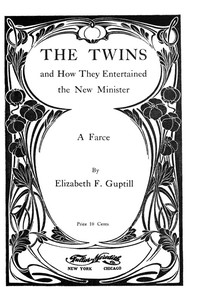
The Twins, and How They Entertained the New Minister: A Farce — Background and Themes
(0 User reviews)
313
Project Gutenberg
2017
Not confirmed
Comedy plays; Twins -- Drama; Clergy -- Drama
Readers of public-domain and historical texts
Project Gutenberg digital edition
en
Edition facts
Words
6,703
Reading time
30 min
Text sections
1
The source record for The Twins, and How They Entertained the New Minister: A Farce — Background and Themes measures this digital text at 6,703 words, 30 min estimated reading time, and 1 detected text section.
The text analysis averages about 16.6 words per sentence, while the detected sections provide another way to judge how the source is divided.
Project Gutenberg metadata also associates the work with “Comedy plays,” connecting these edition facts with the source record’s subject description.
Source:
Project Gutenberg record #55154
A 1914 farce in which twins Bobby and Betty turn a minister's pastoral call into a game of wits, revealing family secrets through their candid, competitive dialogue.
Read the complete public-domain text at its original source.
Read on Project GutenbergThe play opens with Betty directing the minister to the Morris chair—'that's the one sister's beaux always sit in'—before she dashes off to check whether her mother is 'in' or 'out,' a distinction she treats as a matter of household diplomacy. Her brother Bobby soon bursts in, accusing her of cheating at the doorbell-answering game their father invented to stop them from shirking callers. The twins' rapid-fire exchange establishes a farcical tone built on literal-minded logic and sibling rivalry.
Children's Logic and Adult Conventions
The twins treat the minister's visit as an interruption to play, and they have developed a system to manage it: a 'Caller's game' where each answered doorbell earns candy. Betty explains that the only way to know if their mother is 'in' is to go ask her, because 'sometimes she’s in when she isn’t, and sometimes she isn’t when she is.' This paradox, delivered with perfect seriousness, reveals how children navigate adult evasions. Bobby's complaint that Betty 'camp[s] out in the hall to get ahead' of him shows that the game has become a competition, not a chore. The playwright uses the twins' unadorned speech—'aint,' ''twas,' ''taint'—to underscore their youth and their unfiltered perspective on adult social rituals.
The Minister as Straight Man
Rev. J. Jones speaks only a few lines, and those are formal interruptions: 'Tell her that I am making pastoral calls.' The twins pay him no deference; Betty cuts him off with 'I know who you are. “I’m the new minister,” you was a going to say, wasn’t you?' Bobby later asks, 'Beat?' as if the minister were a competitor. The minister's role is to be a passive recipient of the twins' disclosures—a device that lets the audience hear family secrets without the filter of adult politeness. His silence amplifies the children's chatter, making the farce depend entirely on their energy.
Domestic Space as Stage
The setting is a reception room, but the twins treat it as a theater for their game. Betty points out a chair 'only for show' with a broken leg, and the Morris chair reserved for 'sister’s beaux.' These details sketch a home where furniture has assigned social roles. The doorbell is a contested territory; the hall is a place to 'camp out.' The mother remains offstage, a presence the twins negotiate through a logic of 'in' and 'out' that parodies adult social maneuvering. The playwright uses the confined space to concentrate the action on the twins' verbal sparring, turning a routine call into a miniature domestic drama.
Dialect and Authenticity
The twins' speech is marked by colloquial contractions and grammatical informality: 'aint,' 'was a going,' ''taint fair.' The transcriber's note indicates that dialect and alternative spellings were left unchanged, preserving the flavor of early twentieth-century children's vernacular. Bobby's line 'Say, aint it funny to call an afternoon a day?' shows a child's literal confusion over adult language. The playwright does not correct the twins' grammar, allowing their voice to drive the comedy. This choice gives the farce a documentary quality, grounding its humor in the specific way these characters speak rather than in slapstick or plot twists.
The farce relies on a single situation—a minister's call—and the twins' unguarded talk. Readers may notice how the playwright uses the children's limited understanding to expose adult pretenses. The play's brevity (fifteen minutes) and small cast (two males, one female) make it a practical piece for amateur performance, but its interest lies in the precise, unsentimental rendering of how children translate adult rules into their own games.
This farce reminds me of my grandmother’s parlor, where children’s blunt questions once unearthed a quiet scandal. Reading about Bobby and Betty’s candid game, I felt that same flutter of exposure. Perhaps Psyche — Context and Discussion stirred that echo, its inward gaze feeling like a winter window I once pressed my nose against, watching truth melt the frost.
There are no reviews for this eBook.
There are no comments for this eBook.
Reader reflection
How will you remember this book?
Save your reaction, strongest insight, and memorable passage.
Your progress
0
/
10
2
Did this book hold your interest?
3
Is this a title you would suggest to others?
4
Did the language feel accessible?
5
Did this book create an emotional response?
6
Did you gain anything practical from the text?
7
Did you relate to its people, ideas, or situations?
8
Is this a title worth rereading?
9
What changed or sharpened your thinking?
10