1

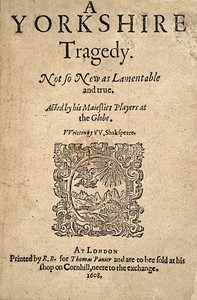
A Yorkshire Tragedy — Context and Discussion
(0 User reviews)
350
Project Gutenberg
2003
Not confirmed
Tragedies (Drama); Shakespeare, William, 1564-1616 -- Spurious and doubtful works; Yorkshire (England) -- Drama
Readers of public-domain and historical texts
Project Gutenberg digital edition
en
Edition facts
Words
9,491
Reading time
42 min
Text sections
2
For A Yorkshire Tragedy — Context and Discussion, the stored edition analysis reports 9,491 words, 42 min estimated reading time, and 2 detected text sections.
The text analysis averages about 15.7 words per sentence, while the detected sections provide another way to judge how the source is divided.
Project Gutenberg metadata also associates the work with “Tragedies (Drama),” connecting these edition facts with the source record’s subject description.
Source:
Project Gutenberg record #4255
This editorial note examines the authorial choices in diction, dialogue, and description in 'A Yorkshire Tragedy,' a play dubiously attributed to Shakespeare. It highlights the colloquial speech of servants, the Husband's violent rhetoric, and the use of stage directions to convey brutality.
Read the complete public-domain text at its original source.
Read on Project GutenbergThe play opens not with a noble soliloquy but with two servingmen, Oliver and Ralph, trading bawdy proverbs. Ralph likens a woman’s longing to ripe apples falling from a tree—‘then tis Common you know for every man to take em up.’ This earthy, proverbial speech sets a domestic, lower-class tone that persists throughout. The dialogue is dense with colloquialisms: ‘Slidd,’ ‘yfaith,’ ‘Mass.’ Sam’s entrance, laden with hats, glasses, and ballads, is described as ‘the true picture of a Common servingman.’ The author uses these details to ground the tragedy in a recognizable, unromanticized Yorkshire household.
The Servants' Vernacular
The servants’ speech is the play’s most distinctive feature. Their exchanges are laced with proverbs and crude humor: ‘any woman bears the more when she is beaten,’ says Sam, and Ralph retorts, ‘aye, that’s true, for she bears the blows.’ The wordplay is deliberate, almost punning. Oliver fears his mistress will ‘run upon the left hand of her wit’ if she learns the truth. These lines reveal character through idiom: the servants are cynical, worldly, and verbally agile. Their dialect—‘neither of either, as the Puritan bawd says’—marks them as distinctly Yorkshire, not courtly. The author uses their chatter to foreshadow the Husband’s brutality while maintaining a grimly comic surface.
The Husband's Violent Diction
The Husband’s speech shifts abruptly from domestic complaint to murderous rage. He calls his wife ‘whore as familiarly as one would call Mal and Dol.’ His commands are terse and imperative: ‘Give me the bastard,’ ‘Brat, thou shalt not live to shame thy house.’ The stage direction ‘Stabs at the child in her arms’ is starkly simple, but the dialogue escalates: ‘Have at his heart!’ After stabbing, he declares ‘There’s whores enow, and want would make thee one.’ His language dehumanizes his family, reducing children to ‘beggars’ and ‘brats.’ The author avoids moralizing; the Husband’s words alone condemn him. Even his curses against his horse—‘stumbling Jade, the spavin overtake thee’—are venomous, suggesting a man whose fury spares no living thing.
Stage Directions as Narrative
The play’s stage directions are minimal but potent. They often describe physical action that the dialogue alone cannot convey: ‘Overthrows him,’ ‘She’s hurt and sinks down,’ ‘He throws her down.’ In Scene V, the direction ‘Stabs at the child in her arms’ precedes the Wife’s cry ‘Oh my dear boy!’ The author uses these terse notes to accelerate the violence, leaving the actors to embody the horror. Later, the servant reports being ‘bruizd’ and ‘rent’ by the Husband’s ‘blood-hasty spur.’ The direction ‘Enter Husband as being thrown off his horse, And falls’ is almost absurdly anticlimactic after the murders, yet it underscores his loss of control. These choices prioritize visceral impact over poetic elaboration.
Repetition and Incremental Horror
The author builds horror through repetition. The Husband’s refrain ‘There are too many beggars’ echoes his earlier dismissal of his children. The Wife’s repeated ‘Oh my children’ after the attack becomes a litany. The servant’s line ‘you have undone us all, sir’ is mirrored by the Master’s ‘a deadly greeting!’ The phrase ‘bleeding infants’ recurs, hammering home the scale of the slaughter. Even the stage direction ‘She recovers life’ is undercut by her own words: ‘Why do I now recover? Why half live?’ This incremental repetition—of phrases, of actions, of images—creates a sense of inescapable doom. The author does not explain the Husband’s motives; the pattern of his violence is the explanation.
Setting as Moral Landscape
The play’s setting is confined to Calverly Hall and its immediate environs. The scenes alternate between interior rooms and the court before the house, with one brief scene on a high road. This claustrophobic geography mirrors the Husband’s domestic tyranny. The Wife’s final line—‘Murder has took this chamber with full hands, / And will ne’er out as long as the house stands’—transforms the house into a haunted space. The author uses the setting to suggest that violence stains the very walls. The high road scene, where the Husband is thrown from his horse, is almost farcical, but it serves to trap him within reach of justice. The physical world of the play is small, but its moral weight is immense.
Readers should attend to the play’s language as a window into character and class. The servants’ earthy proverbs contrast sharply with the Husband’s brutal commands, and the spare stage directions leave much to the imagination. The play’s brevity—under 10,000 words—means every line carries weight. Consider how the author uses repetition and setting to create a sense of inevitability, and how the absence of explicit moral commentary forces the audience to judge the action themselves.
I keep thinking about the Husband’s brutal words in A Yorkshire Tragedy, how violence hides in plain speech. It reminded me of another old playbook, one I found years ago—French without a master — Inside the Classic—where even learning a language feels like a quiet sort of performance. Both linger with me, oddly gentle in memory.
There are no reviews for this eBook.
There are no comments for this eBook.
Reader reflection
How will you remember this book?
Save your reaction, strongest insight, and memorable passage.
Your progress
0
/
10
2
How much did you enjoy the reading experience?
3
Would you encourage someone else to read it?
4
Did the language feel accessible?
5
What did you think about the pace?
6
Would you read this book again?
7
Could you apply anything you learned?
8
What was its emotional impact?
9
In one sentence, what did you learn?
10


![Cover of Faust: a Tragedy [part 1], Translated from the German of Goethe — Edition Insights](https://beqox.com/storage/media/covers/pg14460.jpg)