1

The Greek theater and its drama — Context and Discussion
(0 User reviews)
287
Project Gutenberg
2022
Not confirmed
Greek drama -- History and criticism; Drama -- Technique; Theater -- Greece -- History -- To 500
Readers of public-domain and historical texts
Project Gutenberg digital edition
en
Edition facts
Words
126,939
Reading time
552 min
Text sections
32
The catalog record for The Greek theater and its drama — Context and Discussion provides practical reading context through 126,939 words, 9 hr 12 min estimated reading time, and 32 detected text sections.
The text analysis averages about 17.9 words per sentence, while the detected sections provide another way to judge how the source is divided.
Project Gutenberg metadata also associates the work with “Greek drama -- History and criticism,” connecting these edition facts with the source record’s subject description.
Source:
Project Gutenberg record #69095
A 1918 scholarly work arguing that Greek dramatic conventions arose from physical and social environment, emphasizing technical craft over literary analysis, with detailed scrutiny of festival programs, actor specialization, and the deus ex machina.
Read the complete public-domain text at its original source.
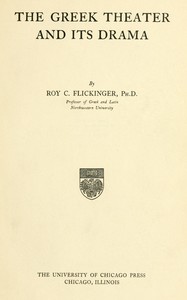
Read on Project GutenbergRoy C. Flickinger’s 1918 study insists that the Greek theater’s conventions—its masks, chorus, three-actor rule, and festival structure—are not arbitrary artistic choices but direct responses to the physical and social environment of ancient Athens. Rather than offering a literary appreciation of surviving plays, Flickinger systematically traces how the orchestra’s shape, the priests’ oversight, and the competitive prize system shaped what playwrights could attempt. The book’s preface frames this as a corrective: earlier scholars had analyzed Elizabethan drama’s debts, but the Greeks’ ultimate influence demanded a more thorough environmental explanation.
Environment as Dramatic Engine
Flickinger’s central thesis—that “the peculiarities and conventions of the Greek drama are largely explicable by its environment”—drives the entire work. He applies this broadly, covering not just theater architecture but also religious festivals, civic funding, and audience expectations. For instance, he notes that the requirement for each tragic poet to present three tragedies and a satyr play “did not go back to the introduction of tragedy by Thespis in 534 B.C.” and cannot be documented for any poet before Aeschylus. This kind of precise, evidence-based revisionism recurs throughout: Flickinger is less interested in praising Greek drama than in showing how practical constraints—like the shape of the theater or the number of allowed actors—produced the formal features that later critics called “classical.”
The Fourth Unity and the Deus ex Machina
A striking section examines what Flickinger, quoting Clayton Hamilton, calls the “unity of mood”—a fourth unity that Greek playwrights preserved even when violating the three unities of action, time, and place. He uses Euripides’ Iphigenia among the Taurians as a test case: the play’s ending, where Orestes’ ship is driven back by a contrary wind, forces divine intervention. Flickinger argues that Euripides deliberately created this insoluble difficulty not to untangle a plot knot but to avoid a “comic” or “burlesque” ending after grave scenes. The deus ex machina here serves to maintain tonal consistency, not to resolve a narrative impasse. This analysis shows Flickinger’s method: he reads a specific technical choice as a response to the sharp generic boundary between tragedy and comedy.
Specialization of Poets and Actors
Flickinger documents that no known Greek poet wrote both tragedy and comedy—“the sock and buskin were not worn by the same poet”—and that actors likewise specialized. He traces prize competitions for tragic actors from 449 B.C. and for comic actors from about 325 B.C., noting that these arrangements “would tend still further to keep each actor within his specialty.” The first performer known to have played both tragic and comic roles is Praxiteles at Delphi in 106 B.C., and only two other pre-Christian instances exist. This specialization, Flickinger argues, explains why Greek tragedies contain little humor and comedies little pain, contrasting sharply with Shakespeare’s “tragical-comical-historical-pastorals.” The evidence is drawn from festival records and inscriptions, not from literary judgments.
Readers should approach this book expecting a technical, source-based argument rather than a survey of Greek plays. Flickinger’s footnotes and references to inscriptions, festival lists, and archaeological findings are integral to his case. The work rewards those interested in how institutional and physical constraints shape artistic form, and it offers a useful corrective to purely literary or aesthetic readings of ancient drama.
There’s something tender about that old 1918 study—how it lingers on the mechanics, the pulleys and masks, as if the craft itself were a quiet kind of faith. It makes me think of a different stage, one where inspectors walk in unannounced. That same patience with human error lives in The Inspector-General — Reading Companion, a gentler shadow of the same old play.
There are no reviews for this eBook.
There are no comments for this eBook.
Reader reflection
How will you remember this book?
Save your reaction, strongest insight, and memorable passage.
Your progress
0
/
10
2
Did this book hold your interest?
3
Would you recommend this book to another reader?
4
How much effort did this book require?
5
How distinctive were its ideas or approach?
6
Did this book create an emotional response?
7
Did the story or argument move comfortably?
8
Could you apply anything you learned?
9
What is the main idea you are taking away?
10