1

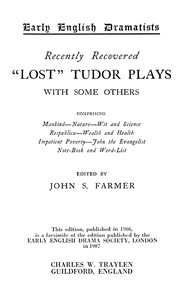
Recently Recovered "Lost" Tudor Plays with some others — Reading Notes
(0 User reviews)
2060
Project Gutenberg
2014
Not confirmed
Moralities, English; English drama -- Early modern and Elizabethan, 1500-1600; Interludes, English
Readers of public-domain and historical texts
Project Gutenberg digital edition
en
Edition facts
Words
116,152
Reading time
506 min
Text sections
24
Before opening Recently Recovered "Lost" Tudor Plays with some others — Reading Notes, the edition data offers a quick orientation: 116,152 words, 8 hr 26 min estimated reading time, and 24 detected text sections.
The text analysis averages about 13.5 words per sentence, while the detected sections provide another way to judge how the source is divided.
Project Gutenberg metadata also associates the work with “Moralities, English,” connecting these edition facts with the source record’s subject description.
Source:
Project Gutenberg record #45805
Editor John S. Farmer presents three recently recovered Tudor interludes—Wealth and Health, Impatient Poverty, and John the Evangelist—with a preface detailing their 1906 discovery in an Irish country house and auction prices. The volume includes a word-list and note-book, offering scholars access to rare pre-Shakespearean moralities.
Read the complete public-domain text at its original source.
Read on Project GutenbergThe three "lost" Tudor plays recovered in 1906—Wealth and Health, Impatient Poverty, and John the Evangelist—arrive in this edition with a preface that reads like a bibliographic thriller. John S. Farmer recounts how a quarto volume of old plays, sent to London auctioneers without a cover, yielded seventeen rare interludes, including four unrecorded editions. The hammer prices are listed: £95 for Wealth and Health, £150 for Impatient Poverty, £102 for John the Evangelist. The British Museum secured the rarest items for the nation. Farmer’s note that the owner “thought so little, or knew so little, of its value” underscores the accidental nature of this recovery.
Debate in Verse: Wealth and Health
The excerpt from Wealth and Health shows a brisk, stichomythic debate between personified abstractions. Wealth boasts that “all the world arise by goods and substance,” while Health counters that “grace, heaven, nor cunning cannot be bought.” The dialogue moves in short, rhyming couplets, each speaker trying to top the other. Wealth claims to be “this realm’s comfort”; Health retorts that wealthy men in pain “were better die.” The argument turns on a moral axis: can ill-gotten goods be redeemed by pious spending? Health insists that “if these goods came with wrong-doing,” no amount of church-building saves the soul. The language is plain, almost proverbial—“not worth a leek”—and the rhythm keeps the exchange urgent.
The Auction Room as Archive
Farmer’s preface provides a rare glimpse into the market for early drama in 1906. He lists each play, its buyer, and its hammer price: King Darius (£132), The Nice Wanton (£169), Lusty Juventus (£140). The buyers include Bernard Quaritch, T. J. Wise, and J. H. Wrenn. Farmer notes that America took The Trial of Treasure and Apius and Virginia, though he “not yet been able to locate them more definitely.” This catalog of sales is itself a historical document, showing which plays were valued most. The preface also speculates on how the plays reached an Irish country house, calling it “a matter of surmise, perhaps idle enough,” but expressing hope that further recoveries may occur “in the most unlikely quarters.”
Voice and Moral Structure
The interludes in this collection operate through allegorical debate, but the voices are not uniform. In Wealth and Health, Wealth speaks in boastful, self-justifying tones, while Health uses a more measured, ethical register. The entry of Liberty, who complains “out of sight, out of remembering,” shifts the dynamic again. The plays are structured as moral arguments, but the characters’ language reveals individual traits: Wealth is blustering, Health is reflective, Liberty is aggrieved. The verse form—rhyming couplets with occasional quatrains—gives each speech a self-contained quality, as if the characters are delivering miniature sermons. Farmer’s word-list and note-book, included at the end, help modern readers navigate the period vocabulary.
Readers approaching this volume should treat the preface as a primary source on the 1906 discovery, not merely an introduction. The auction prices and buyer names offer a snapshot of early twentieth-century bibliophilia. The plays themselves reward attention to their verse forms and argumentative structures; the moral debates are not static but shift with each speaker’s rhetoric. Farmer’s editorial apparatus—the note-book and word-list—is essential for parsing the period language. This edition preserves both the texts and the story of their recovery.
There’s something tender about these rescued interludes—their narrow escape from an Irish attic, their worn pages now ours to hold. I found myself thinking of other fragile survivors, like the Tres Comedias — Reading Companion, sitting nearby on my shelf, quietly waiting. We keep these little volumes close, don’t we? Proof that forgotten things can still find a home.
There are no reviews for this eBook.
There are no comments for this eBook.
Reader reflection
What did you think of this book?
Answer a few questions and save a private reflection on this device.
Your progress
0
/
10
2
How did the book work for you overall?
3
How likely are you to recommend this book?
4
How much effort did this book require?
5
How personally connected did you feel to the book?
6
How did the reading compare with what you expected?
7
Which aspect of the book did you value most?
8
Was the book moving at the right speed?
9
In one sentence, what did you learn?
10