1

Pennsylvania Dutch Rip Van Winkle: A romantic drama in two acts — Background and Themes
(0 User reviews)
57
Project Gutenberg
2017
Not confirmed
Fantasy drama; Pennsylvania German dialect -- Texts; Van Winkle, Rip (Fictitious character) -- Drama
Readers of public-domain and historical texts
Project Gutenberg digital edition
en
Edition facts
Words
15,967
Reading time
70 min
Text sections
3
For Pennsylvania Dutch Rip Van Winkle: A romantic drama in two acts — Background and Themes, the stored edition analysis reports 15,967 words, 1 hr 10 min estimated reading time, and 3 detected text sections.
The text analysis averages about 14.1 words per sentence, while the detected sections provide another way to judge how the source is divided.
Project Gutenberg metadata also associates the work with “Fantasy drama,” connecting these edition facts with the source record’s subject description.
Source:
Project Gutenberg record #55888
E. H. Rauch's 1883 play adapts Washington Irving's story into Pennsylvania Dutch dialect, with a cast of Dutch-named characters and spirits. The excerpts show a bilingual script mixing English stage directions with German-dialect dialogue, a chorus, and a grotesque dance, set across two acts from 1763 to twenty years later.
Read the complete public-domain text at its original source.
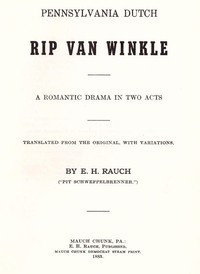
Read on Project GutenbergE. H. Rauch’s 1883 drama Pennsylvania Dutch Rip Van Winkle translates Washington Irving’s story into a bilingual stage script. The title page announces it as “translated from the original, with variations,” and the cast list gives characters such as Derrick Van Slaus and Nicholas Vedder, alongside spirits named Swaggrino, Gauderkin, and Icken. The play is set in two acts, the first in 1763 and the second after a lapse of twenty years.
The excerpts reveal a work that mixes English stage directions with dialogue in Pennsylvania Dutch, a German dialect. The opening chorus refers to “our native land, where flows the Rhine,” and Rip’s speech in Act II includes lines like “Ich glawb by chucks os des all hexa sin” (I believe by jocks that these are all witches). The script also specifies costume changes, such as Rip’s first dress of deer skin and his second, “much worn and ragged.”
Dialect as Dramatic Voice
The play’s most distinctive feature is its use of Pennsylvania Dutch for much of the dialogue. In Act I, Rip’s solo lines are in dialect: “Wann yusht my fraw so goot un fridlich era maul halta date!” (If only my wife would keep her mouth so good and peaceful). The chorus and spirits also speak in dialect, creating a linguistic texture that differs from the English stage directions. This choice aligns with the catalog subject “Pennsylvania German dialect – Texts,” but the excerpts show that dialect is not merely decorative—it carries the humor and character of Rip’s complaints about his wife and his wonder at the spirits. The dialect also marks the play as a local adaptation, distinct from Irving’s original English prose.
Stagecraft and Spectacle
The excerpts include detailed stage directions that indicate a visually ambitious production. The first act ends with a “grotesque dance” as Rip supplies himself from a keg, then “reels forward and sinks in front.” The spirits utter “three ho, ho, ho’s” and some sink through the stage. The second act opens with a transformed landscape: “the bramble is grown into a lofty tree, and all that remains of Rip’s gun is its rusty barrel.” Rip is discovered asleep with “hair gray, and beard grown to unusual length.” These directions suggest that the play relied on spectacle—costume changes, set transformations, and choreographed movement—to convey the passage of time and the supernatural encounter. The catalog subject “Fantasy drama” is supported by these elements, though the excerpts do not reveal the full extent of the spirits’ role.
Narrative Compression and Character
The two-act structure compresses Irving’s story into a tight timeframe. The first act establishes Rip’s domestic situation and his encounter with the spirits; the second act jumps twenty years, showing Rip awakening to a changed village. In Act II, Lorrenna, now a woman, speaks of her orphaned state: “Ich hob kæ eltra g’hot sidder os ich ’n gons klæ maidly war” (I have had no parents since I was a very little maid). This line suggests that the play condenses Rip’s absence into a single generation, focusing on Lorrenna’s plight rather than the broader social changes. The catalog subject “Van Winkle, Rip (Fictitious character) – Drama” is accurate, but the excerpts indicate that the play also gives voice to female characters like Alice and Lorrenna, who are not present in Irving’s original tale.
Readers approaching this edition should note that the text includes both English and Pennsylvania Dutch passages, and that the stage directions provide a blueprint for performance. The play’s bilingual nature may require familiarity with German dialect or a willingness to infer meaning from context. The excerpts suggest a work that is as much about local language and theatrical spectacle as about Rip’s legendary sleep. For those interested in dialect literature or nineteenth-century American drama, this adaptation offers a specific, regional take on a familiar story.
That old play made me think of way stations—souls pausing between what was and what will be, their words half-remembered, half-made. It stayed with me, that Germanic echo. I kept returning to the same worn feeling in Faust — Part 1 — Key Ideas to Explore, where a bargain feels less like a choice and more like weather. Quietly haunting, both of them.
There are no reviews for this eBook.
There are no comments for this eBook.
Reader reflection
Your personal reading reflection
Build a private reading journal entry for this title.
Your progress
0
/
10
2
What was your overall reaction to the book?
3
Would you pass this book on to a friend?
4
Did the language feel accessible?
5
What was the strongest part of the book?
6
How personally connected did you feel to the book?
7
How useful did the reading feel?
8
Would a second reading be valuable?
9
What did this book teach you most?
10