1

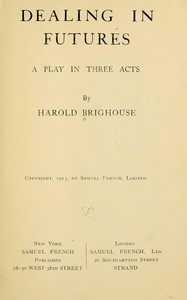
Dealing in Futures: A Play in Three Acts — Background and Themes
(0 User reviews)
809
Project Gutenberg
2017
Not confirmed
Man-woman relationships -- Drama; Fathers and daughters -- Drama; English drama -- 20th century; Lancashire (England) -- Drama; Industrial relations -- Drama
Readers of public-domain and historical texts
Project Gutenberg digital edition
en
Edition facts
Words
25,512
Reading time
111 min
Text sections
4
The source record for Dealing in Futures: A Play in Three Acts — Background and Themes measures this digital text at 25,512 words, 1 hr 51 min estimated reading time, and 4 detected text sections.
The text analysis averages about 9.3 words per sentence, while the detected sections provide another way to judge how the source is divided.
Project Gutenberg metadata also associates the work with “Man-woman relationships -- Drama,” connecting these edition facts with the source record’s subject description.
Source:
Project Gutenberg record #55289
Harold Brighouse's 1913 play pits a chemical manufacturer against his daughter, her fiancé, and a doctor over worker safety, exposing tensions between profit, paternalism, and reform in Lancashire.
Read the complete public-domain text at its original source.
Read on Project GutenbergThe dining-room of Jabez Thompson, a chemical manufacturer, is described as 'luxuriously furnished' and combining 'comfort with ostentation'—a detail that immediately signals the play's interest in the visible markers of industrial wealth. The stage directions note that Jabez speaks 'with all the assertiveness of life-long success,' while his daughter Rosie, though outwardly cultured, has not entirely subdued 'a naturally violent temper.' This opening establishes a household where prosperity and control are on display, but underlying tensions are ready to surface.
Profit vs. Safety in the Chemical Works
The central conflict emerges when Charlie Bunting, Rosie's fiancé, accuses Jabez of poisoning his workers by refusing to install a safety respirator patented by Dr. Walter Clavering. Jabez dismisses the device as a 'cranky respirator' and Clavering's motives as mercenary: 'He wants to do his philanthropy on twenty-five per cent terms at some one else's expense.' Charlie counters that 'everybody's not as mercenary as you,' and that Jabez has 'got so used to expressing every idea in terms of L.S.D.' The exchange reveals a sharp divide between a cost-accounting logic—Jabez argues the business 'won't stand more expense' and that workers are already insured—and a moral argument that compensation does not justify preventable harm. The play does not resolve this debate within the excerpts, but it frames the respirator patent as a flashpoint for larger questions about industrial responsibility.
Generational and Domestic Tensions
Rosie Thompson is described as inheriting her father's 'strength of will,' and her voice is 'a little shrill and shrewish'—a characterization that suggests she is both a product of and a challenge to Jabez's authority. When Jabez admits he is 'not a bit happy over this engagement of yours to Charlie,' Rosie responds curtly with 'Why?' and the stage direction notes that Jabez is 'obviously rather afraid of her.' The family dynamics are further complicated by Charlie's defiance: he plans to 'address the men to-night' in support of Clavering, directly opposing Jabez's interests. Jabez threatens to retaliate against Charlie's father, John Bunting, a master dyer, indicating that business and family loyalties are tightly interwoven. The play's domestic setting—the dining-room and billiard-room—becomes a stage for these intersecting pressures.
The Book as a Weapon
A key prop in the play is a book—presumably Clavering's exposé of factory conditions—which Jabez dismisses as 'intimidation' and 'blackmail.' He threatens to 'buy up the edition' and 'suppress it,' but Charlie warns that 'the publisher happens to be an honest man.' The excerpts include a passage Jabez reads aloud, describing the book as bearing 'on every page the sign-manual of sincerity' and calling for action against 'man's inhumanity to man.' This meta-textual device turns the book itself into a character: it is both evidence of wrongdoing and a tool for public pressure. Jabez's reaction—throwing it in the paper basket—underscores his belief that he can control information, while Charlie's insistence that 'you can't muzzle a man' suggests a faith in public opinion that the play may test.
Readers should attend to how Brighouse uses stage directions and props—the luxurious dining-room, the discarded book, the respirator patent—to embody abstract conflicts. The play's three-act structure, set within twenty-six hours, compresses the dispute into a tight dramatic frame. The excerpts leave unclear whether Clavering's book is published or suppressed, and whether Charlie's address to the men occurs. These gaps invite attention to how the play balances its competing voices without offering easy resolution.
There’s something tender about that Brighouse play—the way safety and stubborn love get tangled up in the same house. It reminded me of the old political quiet in King Henry VI, Part 2 — Reading Notes, where power also whispers through classrooms and kitchens rather than roaring. I still think about both on grey Lancashire afternoons, half-wishing I’d known those rooms.
There are no reviews for this eBook.
There are no comments for this eBook.
Reader reflection
What did you think of this book?
Answer a few questions and save a private reflection on this device.
Your progress
0
/
10
2
Was reading this book enjoyable?
3
Would you recommend this book to another reader?
4
How much effort did this book require?
5
Would you like to discuss this book with someone?
6
Which part made the strongest impression?
7
How clear did the writing feel?
8
How much did the book move you?
9
What did this book teach you most?
10