1

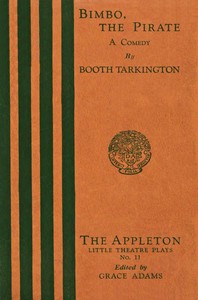
Bimbo, the pirate: A comedy — Context and Discussion
(0 User reviews)
465
Project Gutenberg
2022
Not confirmed
Comedy plays; American drama -- 20th century; Pirates -- Drama
Readers of public-domain and historical texts
Project Gutenberg digital edition
en
Edition facts
Words
11,868
Reading time
52 min
Text sections
6
Bimbo, the pirate: A comedy — Context and Discussion can be approached with a clearer sense of reading commitment from its source measurements: 11,868 words, 52 min estimated reading time, and 6 detected text sections.
The text analysis averages about 13.9 words per sentence, while the detected sections provide another way to judge how the source is divided.
Project Gutenberg metadata also associates the work with “Comedy plays,” connecting these edition facts with the source record’s subject description.
Source:
Project Gutenberg record #69265
Booth Tarkington's one-act comedy follows the pirate captain Bimbo, who enforces strict Sabbath rules aboard his ship, leading to ironic clashes with a captive woman and a tar-smeared prisoner. The play's humor arises from the gap between pirate stereotypes and the crew's self-righteous piety.
Read the complete public-domain text at its original source.
Read on Project GutenbergThe play opens not with a pirate flag or a treasure map but with a swinging brass lantern and a cacophony of trampling feet, bellowings, and a girl's scream abruptly cut off. Booth Tarkington's Bimbo, the pirate: A comedy (1926) announces itself as a theatrical piece that will subvert expectations from the first moment. The stage direction emphasizes sound and motion over visual spectacle, setting the tone for a work more concerned with verbal irony than swashbuckling action.
The catalog subjects list "Comedy plays; American drama -- 20th century; Pirates -- Drama," but the excerpts reveal a comedy that leans heavily on moral paradox. The pirates are not lawless rogues but a "commonwealth of free seamen" governed by rigid rules—especially on the Sabbath, when profanity is banned and religious reading is encouraged. This inversion of pirate tropes is the engine of the play's humor.
Sabbath Observance as Comic Device
The most striking feature of the excerpts is Bimbo's insistence on keeping the Sabbath holy. When Driscoll, a prisoner, curses under the Gunner's hand, Bimbo rebukes him: "We allow no profanity on this vessel on the Sabbath Day." The line is played for laughs, but it also establishes a consistent code. Bimbo's ship has articles that forbid swearing, drunkenness, and women on board—rules drawn from historical pirate codes, as the play's epigraphs show. Yet the comedy arises because these rules are enforced with absurd solemnity by men who have just captured a ship and presumably killed or terrorized its crew.
Lydia, the captive, voices the audience's disbelief: "But you're pirates! What difference does it make to a pi——" Bimbo cuts her off, insisting on the term "commonwealth of free seamen." The exchange highlights the gap between the pirates' self-image and their actions. Tarkington uses this dissonance to generate humor without resorting to slapstick. The Sabbath rule also provides a structural constraint: because the action takes place on a Sunday, the pirates cannot engage in their usual vices, forcing the conflict to play out through argument and moral posturing.
The Common Error of Mankind
Bimbo's longest speech in the excerpts is a sermon on misjudgment. He tells Lydia: "The common error is to misjudge all who walk not in our own way, and to call them sinners." He uses the example of a play actor—a profession he considers sinful—to argue that one should not assume a person guilty of all sins simply because of their calling. The irony is thick: Bimbo is a pirate lecturing a captive on tolerance. Yet the speech is not merely hypocritical; it reveals a genuine, if warped, moral framework.
Tarkington gives Bimbo a vocabulary of self-justification. He confesses to being "an erring creature, not above this error myself," and frames his lecture as a Sabbath-day confession. The language echoes Puritan piety, but the context—a pirate ship with a tar-handed gunner—undercuts any sincerity. Lydia's response, "Why, sin," when asked to name the common error, shows she is not buying it. The play thus uses moral philosophy as a comic weapon, letting the audience enjoy the pirates' self-seriousness while recognizing its absurdity.
Historical Pirate Codes as Source Material
The play's epigraphs are not decorative; they directly inform the comedy. Tarkington quotes from The Pirates of the New England Coast and a seaman's narrative, citing rules against swearing, drunkenness, and women, as well as the requirement to worship God on the Sabbath. The play dramatizes these rules, turning historical curiosities into plot points. For instance, the rule "No women were allowed on board" is violated by Lydia's presence, creating tension. Bimbo's explanation—that the ship's company "live under rigid law and rule"—echoes the language of pirate articles.
By grounding the comedy in real pirate codes, Tarkington avoids anachronism and gives the humor a factual basis. The audience familiar with pirate lore might recognize the irony: the historical pirates who swore on a Bible to avoid profanity were not necessarily pious, but their codes served a practical purpose. Tarkington exaggerates this piety for comic effect, turning Bimbo into a moralist who condemns "Blast your vitals" as profanity while commanding a crew of cutthroats. The play thus offers a satirical take on the gap between rules and behavior, a theme that resonates beyond the pirate setting.
Readers approaching Bimbo, the pirate should pay attention to the stage directions, which carry much of the comedy's timing and tone. The play is short—about 52 minutes of reading—and rewards attention to the interplay between what characters say and what they do. The epigraphs are worth revisiting after reading, as they reveal how closely Tarkington adhered to historical sources while twisting them for laughs. This is not a children's pirate adventure but a sophisticated comedy of manners in an unlikely setting.
Reading about Bimbo’s rigid Sabbath made me recall a summer when my uncle, a gentle man, would read aloud from a dog-eared copy of French without a master — Inside the Classic, its clumsy phrases somehow making our quiet evenings feel like a private joke. That same tender absurdity lingers here, each character’s certainty collapsing into laughter.
There are no reviews for this eBook.
There are no comments for this eBook.
Reader reflection
How will you remember this book?
Save your reaction, strongest insight, and memorable passage.
Your progress
0
/
10
2
How much did you enjoy the reading experience?
3
Would you encourage someone else to read it?
4
How much effort did this book require?
5
Was the book what you thought it would be?
6
How personally connected did you feel to the book?
7
How valuable was this book for your own interests?
8
What was the strongest part of the book?
9
What is the main idea you are taking away?
10