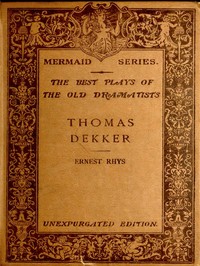
Thomas Dekker Edited, with an introduction and notes by Ernest Rhys. Unexpurgated Edition — Key Ideas to Explore
Edition facts
Thomas Dekker's plays, as presented in this 1887 edition edited by Ernest Rhys, display a distinctive verbal energy that shifts rapidly between prose and verse. In the excerpt from The Honest Whore, Part the Second, the dialogue moves from a quarrel over a pawned gown to a philosophical speech on contentment, all within a few exchanges. Matheo's punning on 'light' (meaning both weightless and morally loose) and Orlando's aside—'I saw my twenty pounds fly high'—illustrate Dekker's habit of embedding economic anxiety within wordplay. The verse passages, such as Lodovico's meditation on worldly goods, adopt a more measured, sententious tone that contrasts with the clipped prose of the opening argument.
Prose and Verse as Social Markers
Dekker uses the switch between prose and verse to signal shifts in social register and emotional intensity. In the excerpt, Matheo and Orlando speak in prose during their heated exchange about money and Bellafront's gown. The prose is colloquial, full of contractions and expletives: ''Sblood, nor I.' When Lodovico enters, the dialogue remains in prose for greetings, but his longer reflection on poverty—'Why should we grieve at want?'—is in regular iambic pentameter. This verse passage is rhetorically structured, with balanced clauses and a moralizing tone that sets Lodovico apart as a figure of worldly wisdom. Bellafront's plea to Matheo also rises into verse: 'A thousand sorrows strike / At one poor heart, and yet it lives.' Her shift from prose to verse marks a moment of heightened emotion, as she moves from practical complaint to existential despair. The alternation is not arbitrary; it cues the audience to attend to changes in status, sincerity, or intensity.
Rapid Exchanges and the Rhythm of Conflict
The dialogue in the excerpt is built from short, overlapping lines that create a sense of urgency and verbal sparring. Matheo and Orlando trade barbs in quick succession: 'Orl. Why, pray sir, employ some of that money you have of mine. / Mat. Thine? I'll starve first, I'll beg first.' The stichomythia-like back-and-forth, though not strictly metrical, mimics the pace of a real argument. Dekker also uses asides to layer private thoughts beneath public speech. Orlando's aside—'I saw my twenty pounds fly high'—reveals his true position while he outwardly offers to act as broker. This technique allows the audience to track multiple perspectives simultaneously. Later, when Bellafront exits for wine, the stage direction is minimal, but the dialogue continues without pause, maintaining momentum. The rhythm of these exchanges reflects the precarious, fast-moving world of Dekker's London, where debts and deals are settled in the space of a few lines.
Puns, Proverbs, and the Texture of Speech
Dekker's language is dense with puns and proverbial phrases that root the dialogue in contemporary idiom. Matheo's line 'your only fashion for a woman now is to be light, to be light' plays on the double meaning of 'light' as both airy and unchaste, linking fashion to morality. The phrase 'pox on them' and 'shift your lodgings' are colloquial curses and practical advice, respectively. Lodovico's speech draws on proverbial wisdom: 'No man wants all things, nor has all in measure.' This aphoristic quality gives his verse a gnomic weight, as if he is dispensing folk wisdom. The excerpt also contains a reference to 'the Mirror of Knighthood,' a popular romance, suggesting Dekker expects his audience to catch literary allusions. These verbal textures create a world where characters speak in a blend of street slang, moral maxims, and theatrical rhetoric, making the language itself a subject of interest.
Readers approaching this edition should attend to the interplay between prose and verse as a guide to character and mood. The editorial apparatus by Ernest Rhys provides historical context, but the plays reward close attention to the rhythm of individual speeches. Noting where Dekker shifts from colloquial prose to formal verse—and where he inserts asides or puns—can illuminate the social tensions and moral ambiguities that drive his plots. The excerpts suggest a playwright who uses language as a tool for both comedy and critique.