1

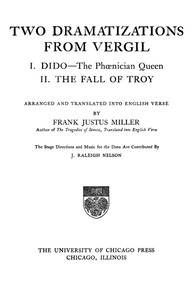
Two Dramatizations from Vergil: I. Dido—the Phœnecian Queen; II. The Fall of Troy — Themes and Context
(0 User reviews)
232
Project Gutenberg
2017
Not confirmed
Trojan War -- Drama; Dido (Legendary character) -- Drama; Virgil -- Adaptations; Epic poetry, Latin -- Adaptations
Readers of public-domain and historical texts
Project Gutenberg digital edition
en
Edition facts
Words
21,190
Reading time
93 min
Text sections
8
Before opening Two Dramatizations from Vergil: I. Dido—the Phœnecian Queen; II. The Fall of Troy — Themes and Context, the edition data offers a quick orientation: 21,190 words, 1 hr 33 min estimated reading time, and 8 detected text sections.
The text analysis averages about 19.3 words per sentence, while the detected sections provide another way to judge how the source is divided.
Project Gutenberg metadata also associates the work with “Trojan War -- Drama,” connecting these edition facts with the source record’s subject description.
Source:
Project Gutenberg record #54717
This editorial note examines how the opening, middle, and later excerpts of Miller's verse dramatization of Dido's story guide a first reading, focusing on the interplay of stage directions, choral interludes, and adapted Vergilian speech.
Read the complete public-domain text at its original source.
Read on Project GutenbergThe preface to this 1908 adaptation frames the epic as "a drama on gigantic scale" and singles out the Dido episode as a "dramatic action well-nigh complete" within the Aeneid. Miller and Nelson have shaped Vergil's narrative into two playable acts, with the first devoted to Dido. The opening pages immediately establish a hybrid form: the translator's English verse is paired with detailed stage directions and original choral lyrics, such as the maidens' song adapted from Tasso. A first reader should note how the text oscillates between faithful rendering of Vergil's lines and theatrical invention—the preface itself warns that "much must be supplied of speech and action" to achieve a full drama.
The Stage Directions as Narrative Guide
The excerpts reveal that stage directions carry much of the emotional arc. In Act IV, Scene 2, Dido's actions are described in precise, almost cinematic detail: she "paces the room with fierce energy," "presses her hand to her head as if a new thought had come," and "stealthily but quickly takes Æneas’ sword from the wall." These cues do more than block movement—they externalize inner turmoil. When Dido "assumes an air of gayety" after concealing the sword, the direction underscores her deception. A reader encountering these passages for the first time should attend to how the physical gestures replace Vergil's interior monologue, making the tragedy visible rather than narrated.
Choral Interludes and Lyric Expansion
Miller and Nelson insert choral songs that have no direct Vergilian source. The maidens' evening hymn—"'T is eve; 't is night; a holy quiet broods"—is credited to Tasso and set to music (the score appears later in the volume). This interpolation creates a pause in the action, contrasting the calm of nature with Dido's sleepless anguish. The chorus describes a world where "beasts lie couch'd amid unstirring woods" and "the fishes slumber," while Dido cries, "But not for me, unhappy one." The effect is to heighten her isolation. First-time readers may find these lyrical breaks disorienting, but they serve as emotional counterpoints, framing Dido's despair within a universal peace she cannot share.
Vergil's Lines Adapted for the Voice
Miller's verse translation, while staying close to Vergil's sequence, reshapes the Latin into a speaking rhythm suited to the stage. Dido's speech to Anna (lines 478–498) retains the epic catalogue—the "Æthiop country," "Atlas," the "Massylian" priestess—but compresses it into a breathless, persuasive monologue. The line "I swear it by the gods / And thee, unwillingly I seek the magic art" captures her duplicity: she invokes divine witnesses even as she lies. Readers familiar with the Aeneid will notice that Miller omits some of Vergil's similes and instead lets the stage business—the lighting of the censer, the drawing of the sword—carry the symbolic weight. The adaptation thus prioritizes dramatic momentum over epic ornament.
The Shrine of Sychaeus as a Recurring Motif
Throughout the Dido play, the shrine of her dead husband Sychaeus appears as a physical and psychological anchor. In Act IV, Scene 1, Dido flees to the shrine and "kneels before it"; in Scene 2, the shrine is "adorned with flowers; fire glows on the altar." The stage directions specify that Dido draws the curtains from the shrine and later lights the censer there. This repeated focus on the domestic altar—a detail Vergil handles more briefly—turns the shrine into a silent witness to Dido's betrayal of her vow. A first reading should track how the object accumulates meaning: it is the site of remorse, of pretended piety, and finally of the suicide that reunites her with Sychaeus in death.
Because the excerpts break off before the play's conclusion, a reader cannot know how Miller and Nelson handled Dido's death or the transition to the second dramatization, The Fall of Troy. The surviving text suggests that the adaptation relies on a collaborative tension between Vergil's words and the editors' theatrical additions. For a first reading, it is useful to treat the stage directions and choral lyrics as co-authors of the drama, not mere supplements. Pay attention to where the text departs from epic conventions—those moments reveal the editors' interpretive choices most clearly.
I’ve always found Dido’s solemn grief a heavy thing to carry home, yet nearby on my shelf sits a gentler companion. This farce, The Trysting Place: A Farce in One Act — Text and Context, whispers the same old ache of missed encounters, but with a twinkling eye. Both know how a doorway changes everything, though one smiles where the other weeps.
There are no reviews for this eBook.
There are no comments for this eBook.
Reader reflection
How will you remember this book?
Save your reaction, strongest insight, and memorable passage.
Your progress
0
/
10
2
Was reading this book enjoyable?
3
How likely are you to recommend this book?
4
What was the reading difficulty like?
5
How personally connected did you feel to the book?
6
Which part made the strongest impression?
7
Could you apply anything you learned?
8
Would you read this book again?
9
What is the main idea you are taking away?
10