1

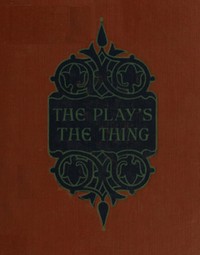
The play's the thing — Edition Insights
(0 User reviews)
1982
Project Gutenberg
2025
Not confirmed
Comedy plays; Triangles (Interpersonal relations) -- Drama; Dramatists -- Drama; Actors -- Drama
Readers of public-domain and historical texts
Project Gutenberg digital edition
en
Edition facts
Words
27,345
Reading time
119 min
Text sections
10
The catalog record for The play's the thing — Edition Insights provides practical reading context through 27,345 words, 1 hr 59 min estimated reading time, and 10 detected text sections.
The text analysis averages about 9.3 words per sentence, while the detected sections provide another way to judge how the source is divided.
Project Gutenberg metadata also associates the work with “Comedy plays,” connecting these edition facts with the source record’s subject description.
Source:
Project Gutenberg record #75451
A 1926 comedy by Ferenc Molnár and P. G. Wodehouse, set in an Italian Riviera castle, where a dramatist and his collaborator manipulate a romantic crisis among a young composer, a prima donna, and an actor. The play's dialogue-driven plot unfolds over three acts with precise timing.
Read the complete public-domain text at its original source.
Read on Project GutenbergThe play opens at two in the morning in a darkened room on the Italian Riviera, where three shadowy figures smoke in silence. The stage direction notes an "embarrassingly long" pause before a voice breaks it. This deliberate pacing—the slow reveal of setting and character through light and sound—establishes a rhythm that the play will exploit throughout. The dialogue immediately signals its tone: witty, self-aware, and layered with theatrical inside jokes. Sandor Turai, a famous dramatist, comments on his own silence, and the banter that follows is crisp and ironic. The play's structure is built around temporal precision: Act I at 2:00 a.m., Act II at 6:00 a.m., Act III at 7:30 p.m. This tight timeline creates a sense of escalating pressure, as the characters work through a romantic entanglement that threatens to unravel their professional and personal lives.
Theatrical Self-Awareness and Dialogue
The play's voice is unmistakably theatrical, with characters who are acutely conscious of their roles. Turai, the dramatist, treats real-life crises as material for a plot, remarking that he considered "several possibilities" during the night. His collaborator Mansky accuses him of "writing psychology" into their last show, a meta-commentary on the play's own blend of farce and character study. The dialogue is peppered with theatrical jargon and self-deprecating humor: Mansky frets about his pallor, Turai deadpans that "walls are much worse" than ceilings. This self-referential quality extends to the stage directions, which describe pauses as "embarrassingly long" and characters' movements with precise blocking. The play does not merely present a story; it constantly reminds the audience that it is watching a constructed performance.
Pacing and Temporal Structure
The three acts are anchored to specific times, compressing the action into a single day. Act I begins in the dead of night, with the stage nearly dark and only the sound of an orchestra playing Leoncavallo's "Mattinata" in the distance. The slow reveal—cigarette ends glowing, a voice breaking the silence—creates a deliberate, almost languid opening. Act II shifts to early morning, with characters in white flannels and a breakfast scene that contrasts Turai's calm appetite with Mansky's agitation. The pace quickens as Turai outlines his plan to manipulate the young composer Adam. By Act III, set at 7:30 p.m., the tempo likely accelerates toward resolution. The play uses these temporal markers to build suspense and underscore the characters' emotional arcs, from confusion to calculated intervention.
Character Dynamics and Comic Contrast
The central trio—Turai, Mansky, and Adam—are defined by their contrasting responses to crisis. Turai is unflappable, eating ham with relish while Mansky despairs. Mansky, the anxious collaborator, provides a foil to Turai's cool pragmatism; his lines are full of exclamation and physical comedy ("Gobble—gobble—gobble!"). Adam, the young composer, is silent and miserable, his suffering rendered in stage directions rather than words. The play's humor arises from these mismatched temperaments: Turai's elaborate schemes, Mansky's histrionics, and Adam's mute despair. The excerpts show a pattern of Turai defusing tension with absurd non sequiturs, as when he praises the ham in the midst of a crisis. This comic contrast extends to the physical staging—Mansky crosses to a mirror to check his pallor, while Turai remains seated, eating.
Readers should attend to the play's use of silence and interruption. The opening pause is not merely atmospheric but a structural device that recurs in the dialogue, where characters cut each other off or trail into ellipses. The play's rhythm depends on these gaps as much as its witty exchanges. Also note the function of offstage sounds—the distant orchestra, the tissue-paper walls—which create a world beyond the set. The play is a comedy of manipulation, but its real subject may be the mechanics of storytelling itself.
Years at this desk have taught me how often a play about timing, like Molnár and Wodehouse’s castle comedy, shares a quiet heartbeat with a one-act farce that simply trusts its own hurried clock. Both know the sweet, awkward moment when a door opens too soon. They sit together on the shelf, old friends. The Trysting Place: A Farce in One Act — Text and Context whispers the same gentle secret.
There are no reviews for this eBook.
There are no comments for this eBook.
Reader reflection
What did you think of this book?
Answer a few questions and save a private reflection on this device.
Your progress
0
/
10
2
How much did you enjoy the reading experience?
3
Would you pass this book on to a friend?
4
How demanding did the text feel?
5
Did you gain anything practical from the text?
6
Could you follow the author’s main argument?
7
How personally connected did you feel to the book?
8
How distinctive were its ideas or approach?
9
In one sentence, what did you learn?
10