1

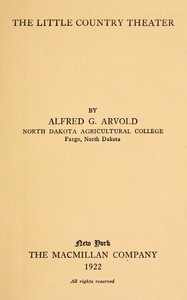
The little country theater — Key Ideas to Explore
(0 User reviews)
890
Project Gutenberg
2022
Not confirmed
Little Country Theater (Fargo, N.D.); Theater -- North Dakota -- Fargo; Little theater movement
Readers of public-domain and historical texts
Project Gutenberg digital edition
en
Edition facts
Words
39,352
Reading time
172 min
Text sections
20
Before opening The little country theater — Key Ideas to Explore, the edition data offers a quick orientation: 39,352 words, 2 hr 52 min estimated reading time, and 20 detected text sections.
The text analysis averages about 13.5 words per sentence, while the detected sections provide another way to judge how the source is divided.
Project Gutenberg metadata also associates the work with “Little Country Theater (Fargo, N.D.),” connecting these edition facts with the source record’s subject description.
Source:
Project Gutenberg record #68514
Alfred G. Arvold's 1922 manual blends a full-length play script, practical stagecraft, and community-building philosophy to argue for rural theater as a tool against social stagnation, using North Dakota's Little Country Theater as a case study.
Read the complete public-domain text at its original source.
Read on Project GutenbergAlfred G. Arvold opens The Little Country Theater not with a preface but with a complete three-act play, "The Raindrops," whose dialogue immediately establishes the book's central tension: rural contentment versus urban allure. In the first scene, Hiram tells Ethel that meeting a new friend gives him "as much joy as findin' a dollar bill in my pocket that I didn't know I had there," a folksy simile that grounds the play in a specific, agrarian idiom. The script's stage directions—"Toy balloon whistles can be heard at different intervals, some louder than others"—reveal a director's attention to layered sound, while the accidental entrance of a trained dog is treated as a happy accident, suggesting Arvold's pragmatic, improvisational approach to staging.
Dialect as Character Marker
Arvold uses nonstandard speech to distinguish his rural characters from city dwellers. Hiram's "Most birds finds a mate when they get full feathered" and Mr. Benson's exclamation "By jingo and jumpin' John Rogers" are not merely colorful; they signal a worldview rooted in farm life and direct experience. The city characters, by contrast, speak in standard English, creating a linguistic divide that mirrors the thematic conflict. This choice is deliberate: Arvold is not simply recording how people talk but using dialect to build empathy for the country folk, whose wisdom is couched in homely metaphor. The effect is theatrical but grounded, suggesting that the author sees language as a tool for social advocacy.
The Play as Blueprint
"The Raindrops" serves a dual purpose: it is both a sample script and a demonstration of Arvold's principles. The plot—a farm family moves to the city, grows discontented, and is rescued by a relative who builds them a house back on the land—enacts the book's thesis that rural life offers a superior form of happiness. The play's structure, with its picnic scene and baseball game, mirrors the community events Arvold later describes in chapters like "Characteristic Incidents" and "Forty Towns." By embedding the argument inside a drama, Arvold practices what he preaches: theater as a vehicle for social change. The script's simplicity—no complex sets, small cast, everyday situations—makes it reproducible by any rural group.
Staging the Rural Ideal
Arvold's stage directions reveal a preference for naturalistic detail over spectacle. In Act II, the picnic grounds are evoked through sound cues—"auto horns tooting occasionally"—and props like a "spring buggy seat" and a "large box" of food. The dog that "walked across of his own accord" is incorporated into the scene, a moment that Arvold clearly relishes as an example of happy serendipity. This willingness to let real life intrude on performance aligns with his broader philosophy: the theater should be an extension of community life, not a separate, polished world. The play's humor is gentle, its conflicts mild, and its resolution swift—qualities that make it an accessible template for amateur troupes.
From Script to Movement
The excerpts from later chapters are not included, but the table of contents hints at a progression from the play to a wider movement. Chapter titles like "The Heart of a Prairie" and "A Bee in a Drone's Hive" suggest that Arvold uses the play as a springboard into essays on community organizing, pageantry, and the history of the Little Country Theater itself. The appendices likely contain practical guides, while the list of illustrations—including folk dances, county play days, and community buildings—indicates a focus on replicable models. The book thus functions as a hybrid: part manifesto, part manual, part script collection, all aimed at proving that "the theater is a crucible of civilization," as Victor Hugo's epigraph declares.
Readers should approach The Little Country Theater as a period document that combines earnest advocacy with practical how-to. The play at the front is not a literary work to be judged by modern standards but a tool designed for immediate use. Arvold's voice—optimistic, plainspoken, and deeply local—shapes every page. Those interested in the little theater movement, early twentieth-century rural sociology, or the history of community arts will find this a revealing primary source. The book's value lies not in its literary polish but in its concrete vision of how drama might revitalize small-town life.
Arvold’s little manual always felt to me like a hand reached across the prairie, reminding neighbors that a shared story could quiet the winter’s lonely hum. There is a similar ache in King Henry VI, Part 3 — A Reader’s Guide, where the realm unravels and everyone just longs for home. Both whisper: gather close, speak plainly, hold the thread. It’s a tender, familiar grief.
There are no reviews for this eBook.
There are no comments for this eBook.
Reader reflection
What did you think of this book?
Answer a few questions and save a private reflection on this device.
Your progress
0
/
10
2
What was your overall reaction to the book?
3
Would you recommend this book to another reader?
4
Did the language feel accessible?
5
Is this a title worth rereading?
6
How would you describe its reading pace?
7
Would you like to discuss this book with someone?
8
How clear did the writing feel?
9
In one sentence, what did you learn?
10